ACT Scores: What Colleges Actually Want (2026 Guide)
For nearly three years, it looked like standardized testing was quietly fading out. Schools went test-optional during the pandemic, applicants flourished without submitting scores, and admissions messaging felt increasingly like: your story matters, the numbers don't. Then came 2025. Harvard reinstated its requirement. Stanford followed. Yale, Brown, Cornell, Dartmouth, and Penn all did the same. The experiment ended, not with fanfare, but with a stack of quiet policy updates on admissions websites. If you're applying in 2026, ACT scores are squarely back in the picture — and knowing what different schools actually want from them is no longer optional.
Understanding the ACT Scale
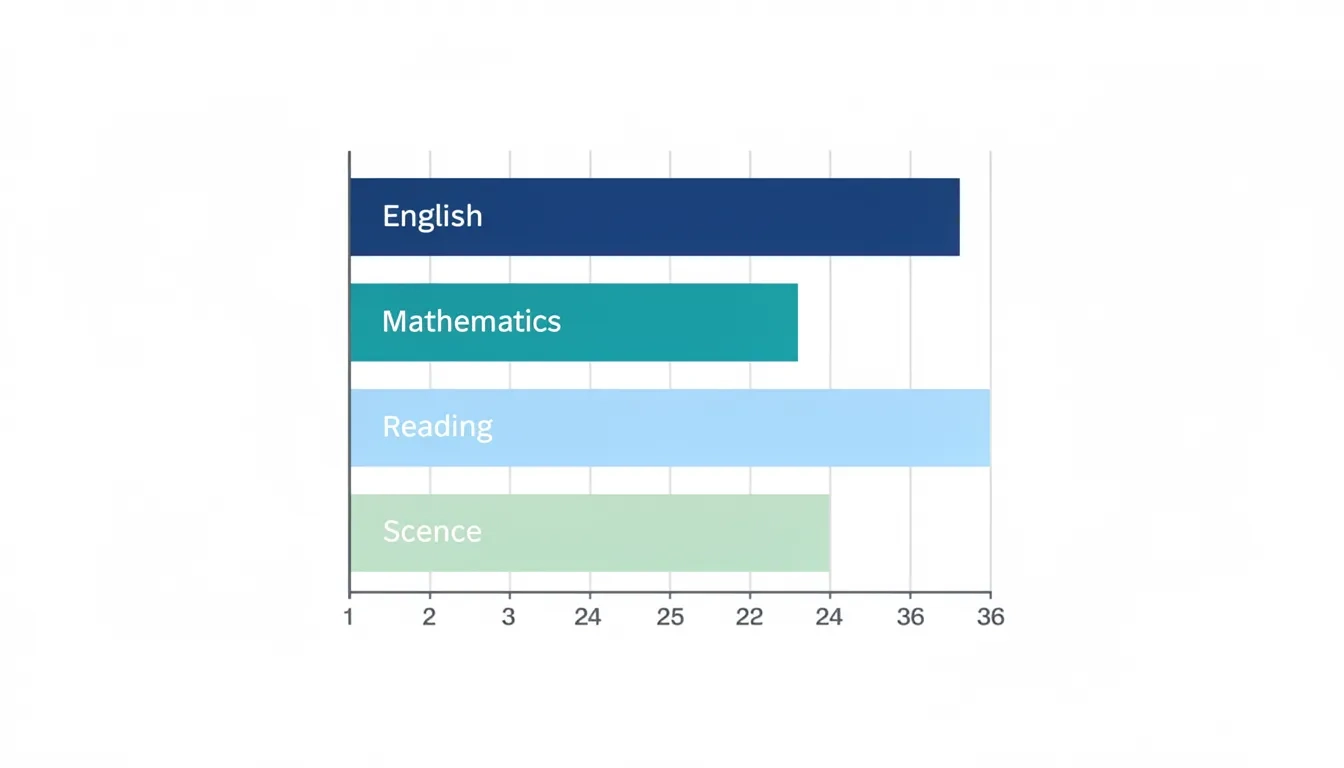
The ACT is scored on a 1–36 composite scale, built from four sections: English, Mathematics, Reading, and Science. Each section runs 1–36, and the composite is the rounded average of all four. There's also an optional Writing test scored separately — most colleges ignore it, but a handful of programs still require it.
The 2025 national average composite sat at 19.5, according to ACT.org. A 20 puts you just above the national midpoint. That sounds encouraging until you check what your target schools' admitted classes actually look like.
The national percentile data is what tells the real story:
| Composite Score | National Percentile |
|---|---|
| 34–36 | 99th |
| 32–33 | 97th–98th |
| 30–31 | 94th–96th |
| 27–29 | 88th–92nd |
| 24–26 | 80th–86th |
| 21–23 | 68th–76th |
| 18–20 | 52nd–63rd |
A 32 puts you at the 97th percentile nationally. That sounds like it should open every door. At schools where 33 is the bottom of the admitted class, it's a below-average score.
What Your Target Schools Actually Want
This is where most students go wrong. They aim for "a good score" without checking what their specific target schools report for admitted students. Colleges publish what's called a mid-50% range: the 25th and 75th percentile composite scores for the people they actually admitted. If your score lands at the 25th percentile, a quarter of admitted students scored below you. Hitting the 75th percentile means three-quarters did.
Aim for the 75th percentile of your reach schools, not the median. A score at or above the 75th percentile becomes an asset; near the 25th, it raises questions.
Here's what the tiers look like in practice:
| Selectivity Tier | Example Schools | Mid-50% ACT Range |
|---|---|---|
| Most Selective (<10% admit rate) | Harvard, MIT, Stanford, Yale | 34–36 |
| Highly Selective (10–20%) | Georgetown, Carnegie Mellon, Johns Hopkins | 31–35 |
| Selective (20–40%) | Univ. of Florida, Univ. of Georgia | 27–33 |
| Moderately Selective (40–60%) | Purdue, Ohio State, Univ. of Alabama | 22–30 |
| Less Selective (>60%) | Many regional state universities | 17–23 |
Harvard reported a 25th-75th percentile range of 34–36 for its most recent admitted class, with an average composite of 35. One important nuance about Harvard specifically: they do not superscore the ACT. They evaluate your strongest single sitting, not a custom composite built from your best sections across multiple dates. That matters for planning retakes.
That "less selective" bottom tier also masks real variation. A school with an 80% acceptance rate might still require a 22 for its nursing program even if the overall admitted-class average is lower.
The Test-Optional Trap
I'll be direct: the phrase "test-optional" has genuinely misled a lot of students. When a school doesn't require scores, many applicants hear "test scores don't matter here." That's not what it means.
Test-optional means you choose whether to submit. It doesn't mean scores are neutral. A strong score still helps at most of these schools — and a weak one, if you send it, still hurts.
The submission question is straightforward once you have the right data:
- Score at or above the school's median? Submit.
- Score clearly below the school's median? Don't. You're not taking the neutral path; you're flagging a weakness.
- Score right at the borderline? Ask whether the rest of your application needs a boost or can stand on its own.
The University of California system (Berkeley, UCLA, UC San Diego, and the other campuses) is a genuine exception. They are test-blind, meaning they will not look at scores even if you send them. That policy is real, not a soft test-optional.
And for the growing list of schools that have reinstated requirements — Harvard, Stanford, Yale, Brown, Cornell, Dartmouth, Penn — there's no strategy to run. You need a competitive score.
How Admissions Readers Actually Use Your Score
A high ACT score doesn't get you into college. What it does is keep you in the room.
At the most selective schools, applications move through roughly two passes. The first is an academic viability screen. The second is the full-picture review, where essays, recommendations, extracurriculars, personal context, and academic trajectory all come in. ACT scores matter most in that first pass. MIT received over 26,000 applications for the Class of 2029 and admitted fewer than 1,300 students. A score below 34 doesn't disqualify anyone, but it creates a headwind before a single essay gets read.
In the deeper review, the score becomes one data point among many. A 32 from a student at an under-resourced rural public school reads differently than the same 32 from someone who attended a prep school with 12 AP offerings. Admissions officers know this. Context doesn't erase the score; it reframes it.
Section C9 of the Common Data Set is the most honest signal each school publishes about how much ACT scores actually matter there. Every school publishes a CDS annually — searchable as "[school name] Common Data Set 2024-25." Section C9 lists whether each admission factor is "Very Important," "Important," "Considered," or "Not Considered." That table tells you more about a school's real priorities than any admissions FAQ or campus tour script.
Some schools also superscore the ACT, combining your best section scores across multiple test dates into a single composite. If Reading is your weak point, a targeted retake can improve just that section and lift your superscore. But again — Harvard doesn't superscore, so one strong single sitting beats several uneven ones there.
The Scholarship Angle Most Students Miss
Even students focused on admissions often miss what ACT scores do for financial outcomes. This is a real oversight.
Merit aid is quietly significant. The University of Alabama publishes an explicit scholarship matrix tied to ACT scores. As of 2025-2026 figures, a composite of 32 or higher qualifies for their Presidential Elite scholarship, covering full tuition. A composite of 28–31 earns the Presidential Scholarship at roughly $26,000 per year, renewable for four years. The difference between a 27 and a 28 on the ACT — one point — is worth more than $104,000 at that single school over a four-year degree. Alabama is unusually transparent about this structure; dozens of schools operate similarly without publishing the thresholds as clearly.
There's a nuance specific to test-optional schools: many of them still require ACT scores to unlock merit scholarships, even if scores aren't needed for admission. You can get in without testing. You can't always get the scholarship money without it. According to ACT's own guidance, students who submit a score qualify for more scholarships even at schools where the score isn't required for admissions review. Always check the financial aid requirements as a separate step from the admissions requirements — they live on different pages, and they are not always consistent with each other.
When to Retake (and When to Stop)
The ACT can be taken up to 12 times, though most students stop long before that. According to ACT's own research, the average score improvement from a first to second sitting is about 2.9 points. After a third attempt, gains typically flatten out.
A practical framework for deciding:
- Score is below the 25th percentile of target schools. Retake, with a targeted prep plan built around your specific weak sections.
- Score is near the median. Retake only if you have time for serious, structured prep and can identify exactly what to improve.
- Score is at or above the 75th percentile of your reach schools. Stop. Your prep time is now worth more on essays and applications.
- Score is 34 or higher. Moving from 34 to 36 will not meaningfully change outcomes at any school. Redirect that energy.
Timing matters here too. Early decision and early action deadlines typically land in early November. ACT scores can take 3–8 weeks to post. That means September is usually the last viable test date for fall applications — which means junior year needs a testing calendar, not a last-minute scramble in October.
One more thing about the Writing section: almost no schools require it anymore, including every Ivy League school. But some nursing, education, and teacher certification programs still ask for it, as do specific programs in several public university systems. Check before opting out — discovering mid-senior year that one school on your list requires Writing means retaking the full test.
Building Your Personal Score Target
Working backward from your college list is the cleanest approach. Here's the process:
- List every school you plan to apply to, including your safeties and likely admits.
- Pull the mid-50% ACT range for each school from their Common Data Set.
- Set your target at the 75th percentile of your highest-reach school.
- Check whether any test-optional schools on your list require a score for merit scholarships.
- Look up superscoring policies — schools that superscore reward multiple sittings; schools like Harvard don't, so plan accordingly.
One misconception worth addressing: you don't need a single flawless score to get into selective schools. What you need is a score that doesn't create doubt. At a school like Stanford (mid-50% range of 34–35), a 33 isn't an automatic pass over — but it means every other part of your application has to be exceptionally clean. Scores set a floor. They don't define a ceiling.
Bottom Line
The test-optional era looks, in hindsight, more like a long detour than a destination. Selective schools have spoken: they find scores useful predictors, and they've reinstated requirements to prove it.
- Know your target range. Pull the mid-50% ACT range from the Common Data Set for every school on your list. Aim for the 75th percentile of your reach schools, not the median.
- Don't submit a below-median score at test-optional schools. You're not being neutral — you're adding a liability.
- Check merit aid requirements separately. A test-optional admissions policy doesn't automatically extend to scholarship programs. The difference can be tens of thousands of dollars.
- Retake strategically. ACT's research shows an average gain of 2.9 points from first to second sitting. Know when the marginal return drops off and spend your remaining prep time on essays.
- Read Section C9 of the Common Data Set. It's free, it's official, and it tells you exactly how much each school actually weights standardized tests. Most students have never read it. That's a meaningful edge for the ones who do.
Frequently Asked Questions
Is a 28 a good ACT score?
A 28 puts you at the 91st percentile nationally — genuinely strong performance. Whether it helps your application depends entirely on where you're applying. A 28 is competitive at many state flagships and mid-tier private schools, but it falls below the 25th percentile at Harvard, MIT, or Stanford. For a realistic, well-balanced list, a 28 is a real asset at the majority of schools on it.
What ACT score do the most selective schools want?
Schools with acceptance rates under 10% typically report mid-50% ACT ranges of 34–36. Harvard's most recent admitted class showed a 25th percentile of 34 and 75th percentile of 36. Scoring below 33 doesn't disqualify an application, but something exceptional elsewhere in the file needs to offset the gap.
Do I need to submit an ACT score to a test-optional school?
Not for admission — but possibly for money. Many test-optional schools still require an ACT score to qualify for merit scholarships, even when scores aren't needed for admissions review. Never assume the two policies match. Check them separately on the school's official financial aid and admissions pages.
Will colleges see all my ACT attempts?
By default, ACT offers score choice: you send only the test dates you select. Some schools ask applicants to submit all sittings, so check each school's testing policy. Superscoring schools often prefer receiving all dates anyway, since they'll build a composite from your best sections regardless of how many attempts it takes.
How does superscoring work, and which schools do it?
Superscoring means a school takes your highest section score from each test date and assembles a new composite from those peaks. If you scored 35 in English on one date but 36 in Math on another, a superscoring school sees both of those best scores combined. Harvard, notably, doesn't superscore — they evaluate your single strongest sitting. Always check a school's superscoring policy before deciding whether multiple attempts make sense.
Is the ACT Writing section required?
For most schools: no. Ivy League schools, MIT, Stanford, and the majority of selective colleges don't require the ACT Writing test. Some nursing, education, and teaching certification programs still ask for it, and a few public university systems have program-specific requirements. Verify before opting out — retaking the full exam just to add Writing is an avoidable situation if you check in advance.
Sources
- SAT and ACT Policies and Score Ranges for Popular Colleges — Compass Education Group
- ACT National Ranks & Score Percentiles — ACT.org
- ACT Test Optional: Official Guidance — ACT.org
- College Admissions: The Role of the ACT, SAT, and CLT in a Test-Optional Landscape — Peterson's
- Harvard ACT Scores: Full Breakdown — NextAdmit
- What's a Good ACT Score for College Admissions — U.S. News & World Report