Active Learning for Better Retention: What the Research Actually Says
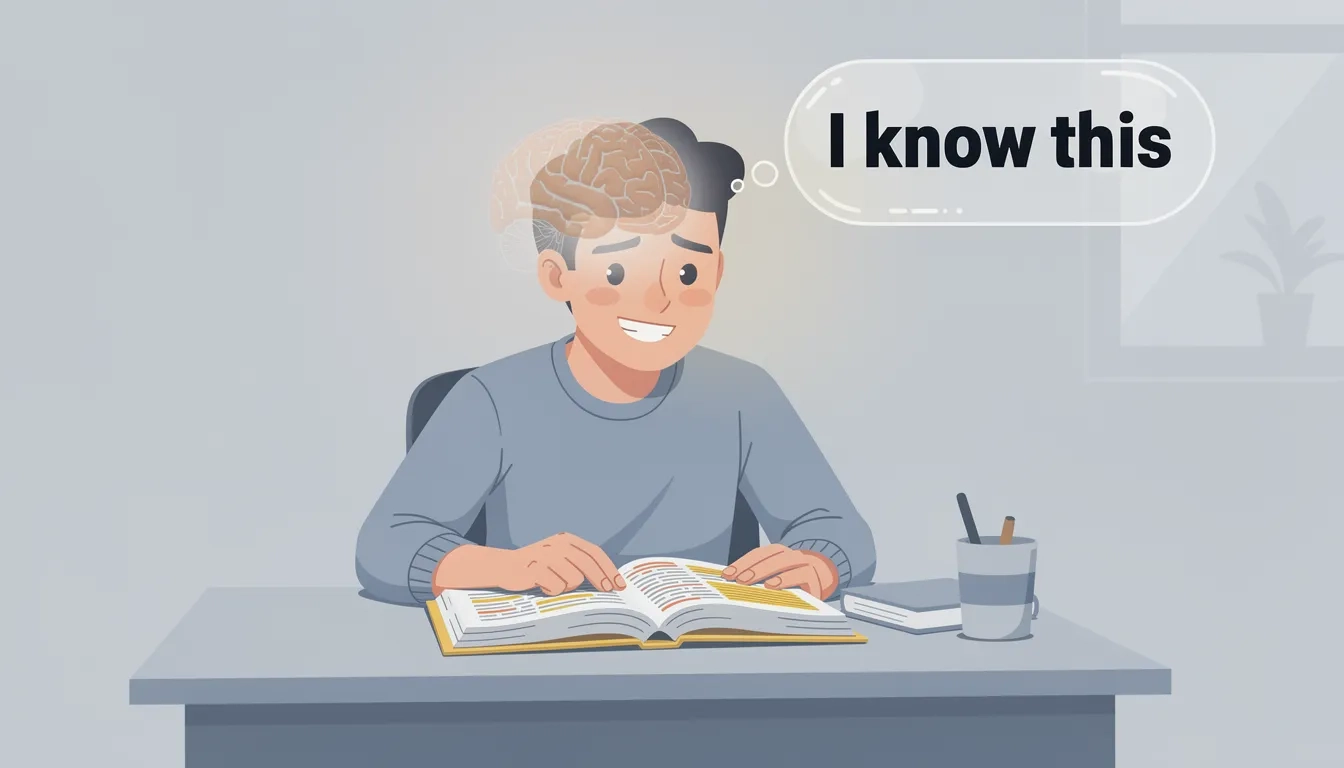
In a 2025 survey by Engageli, 62.5% of students reported feeling well-prepared after passive study sessions — re-reading notes, watching lecture replays, highlighting key passages. Only 52.9% felt confident after active learning. Yet on actual tests, the active group scored 54% higher. The method that feels like studying often isn't. And the methods that feel effortful? Those are the ones that build durable memory.
The Illusion of Knowing
Familiarity isn't the same as memory. When you re-read material you've covered before, your brain recognizes it — and that recognition fires as understanding. Psychologists call this "familiarity memory." It's shallow, fades fast, and creates dangerous overconfidence about what you actually know.
John Dunlosky's influential 2013 review in Psychological Science in the Public Interest evaluated ten widely-used study techniques and rated both highlighting and re-reading as "low utility." Those two methods dominate how most students study. Old habits die hard, especially when no one ever explicitly taught them a better way.
The deeper issue: passive methods are comfortable. No confronting what you don't know, no failure, no friction. Students who re-read material consistently overestimate how they'll perform — they score lower than predicted, feel blindsided, and then re-read more. The illusion of competence doesn't just feel convincing; it actively blocks people from switching to methods that work.
What Active Learning Does to Your Brain
When you generate, retrieve, or explain information rather than just receive it, your brain recruits a broader fronto-temporal encoding network. A 2024 paper in Neuroscience & Biobehavioral Reviews confirmed that self-generation of material activates this network more robustly than passive review — producing memory traces that are both deeper and more accessible later.
Active learning also engages the brain's reinforcement learning circuit. Each successful retrieval tags a memory as "useful" via a dopamine signal, strengthening it in a way passive exposure cannot replicate. Your brain literally treats retrieved memories differently than received ones.
Then there's the generation effect. When you create your own examples, summaries, or questions rather than consuming pre-made ones, retention improves by 15–30% over reading the same material. MIT saw this institutionally: after transitioning introductory courses to active learning formats, they reported a 50% drop in failure rates. The brain doesn't store what you receive. It stores what you do.
The Testing Effect: The Highest-Leverage Change You Can Make
Here's the most replicated finding in learning science: testing yourself is more effective for long-term memory than restudying. Not supplementary to studying. More effective than it.
Henry Roediger and Jeff Karpicke's landmark 2006 paper in Psychological Science showed this with precision. Students who studied a passage once and then practiced retrieval retained 80% of the material after one week. Students who spent equivalent time re-reading retained just 34%. A single retrieval session more than doubled long-term retention.
This phenomenon (sometimes called the "retrieval practice effect") is documented across over 300 studies. The mechanism: every retrieval attempt modifies the underlying memory trace, making it stronger and easier to access next time. You're not just measuring knowledge — you're deepening it.
One underrated application is pre-testing: attempting questions about material before you've studied it. Even wrong answers help. Rea, Wang, Muenks, and Yan (2022) confirmed that unsuccessful pre-tests still produce better learning outcomes than no pre-test at all — the failed attempt primes your brain to notice and encode the correct information when it appears.
How to apply retrieval practice in a study session:
- Close your notes after reading a section and write down everything you recall — no peeking.
- Start each new session with 5 minutes of free recall on previous material before opening any resources.
- Use flashcards actively: attempt an answer before flipping.
- Explain a concept aloud without notes and mark every point where you stall — those gaps are your actual study targets.
Spaced Repetition: Timing Beats Total Hours
Hermann Ebbinghaus mapped this in 1885. His forgetting curve showed that memories decay exponentially without reinforcement — dropping from near-complete retention to below 40% within 24 hours of initial learning. Studying more on day one doesn't fix this. Studying at the right times does.
Spaced repetition schedules reviews at expanding intervals, revisiting each memory just before it would otherwise fade. Optimal intervals for most material look like: review 1 day after initial learning, then 3 days later, then 1 week, then 2 weeks, then 1 month. A 2008 study found students using this approach scored 85% higher on final exams than peers using massed practice — and often studied less total time.
| Method | 1-Week Retention | 1-Month Retention |
|---|---|---|
| Re-reading | ~50% | ~20% |
| Cramming | ~65% | ~20% |
| Spaced repetition | ~80% | ~80% |
| Spaced + retrieval practice | ~85%+ | ~80%+ |
Anki (a free, open-source flashcard app built on spaced repetition algorithms) is the most widely-used practical tool here. But the algorithm matters less than the habit. Any scheduled review system beats a single-sitting marathon. The key is breaking the cultural assumption that more hours on a single day equals more learning.
Interleaving: When Struggle Is the Mechanism
Blocked practice is the intuitive default: master all of Topic A, then Topic B, then Topic C. It feels clean and logical. The research consistently shows it underperforms.
Rohrer and Taylor's 2010 geometry study is the benchmark. Students using blocked practice — all problems of one type before moving on — scored 20% accuracy on the final test. Students using interleaved practice — problem types mixed randomly — scored 63%. That 43-percentage-point gap came from a scheduling change alone, with zero additional study time.
Students consistently rate interleaved practice as harder and less productive than blocked practice — even when their test scores tell a completely different story.
Why interleaving works is called the discriminative-contrast hypothesis. When problems are mixed, your brain must identify which strategy applies before executing it. You're training judgment alongside knowledge. This matters most in real-world settings where problems don't arrive pre-labeled by category.
One important nuance: complete beginners do better with some initial blocked practice to build minimal familiarity before mixing. Block first to establish basic competence. Interleave once you have footing.
Elaboration and the Feynman Test
Elaborative interrogation — asking "why" and "how" while studying rather than just "what" — produces 50–100% better comprehension compared to reading alone. Not because the questions are magical, but because they force your brain to build connections rather than store isolated facts.
The Feynman Technique is the formalized version of this. Richard Feynman was famously precise about distinguishing knowing a name from knowing a thing. The method: explain a concept as if teaching someone with no background, locate the exact points where your explanation gets fuzzy, and return to the source to fill only those specific gaps. Students using this approach score 28% higher on comprehension tests and retain material 40% longer than peers using conventional review.
What makes it powerful is diagnostic precision. Most passive study produces a vague sense that you "kind of get it." The Feynman approach forces you to locate your ignorance with specificity — a fundamentally different cognitive operation.
Pair this with dual coding, from Allan Paivio's research: processing information both verbally and visually improves recall by 67% compared to verbal-only processing. Spending 3 minutes sketching a rough diagram of a process you just read about gives your brain a second retrieval path to the same information, and that redundancy pays off weeks later.
Building a Learning System That Compounds
No single technique carries the whole load. Research shows combination strategies outperform any single approach — spaced retrieval practice, for instance, yields roughly 25% better outcomes than either spacing or retrieval practice used in isolation.
Here's a practical per-session workflow that integrates the major techniques:
- Pre-test (5 min): Attempt to recall or answer questions on material before reviewing it. Get things wrong. That's not a warm-up — it's the mechanism.
- Study (15–25 min): Read or engage with source material. Take sparse, generative notes — don't transcribe.
- Free recall (10 min): Close everything. Write down all you can remember. Use the Feynman frame: explain it simply, note every breakdown.
- Draw (3 min): Sketch one visual representation — a diagram, map, or timeline.
- Schedule: Write the date for your next review — tomorrow, then 3 days, then 1 week.
The most common failure mode is treating these as separate activities rather than one integrated workflow. Students who use retrieval practice but cram the night before an exam undo much of the spacing benefit. These methods compound only when you let them run on the same timeline.
Bottom Line
- Replace one re-reading session this week with free recall — close your notes, write everything you remember, then check. The gap between what you thought you knew and what you can actually retrieve will tell you everything.
- Schedule reviews, not just study time. The question isn't how many hours you put in — it's when. Spaced repetition with 80% retention after a month beats cramming with 20%.
- Embrace the discomfort of interleaving and retrieval practice. Feeling like a session is hard is not a sign you're doing it wrong. It's evidence you're doing it right.
- The perception-performance gap is real and large: active learning feels worse in the moment and outperforms passive review by wide margins over time. Knowing this changes what you reach for the next time you sit down to study.
Frequently Asked Questions
Does retrieval practice work for understanding concepts, or only for memorizing facts?
The testing effect was originally studied in rote memorization contexts, but the research has expanded significantly. Studies now show retrieval practice improves conceptual understanding, problem-solving transfer, and procedural skills — not just fact recall. The effect is strongest for material that needs to be accessible under pressure, where active retrieval during study closely mirrors the retrieval demands of real-world application.
How long should a spaced repetition review session actually be?
Much shorter than most people assume. The goal is to test retrieval, not re-study. A 15–20 minute review session covering material from the day before is more effective than a 90-minute re-read of the same material. If you're using Anki, 20 focused minutes per day beats a 2-hour session once a week — the spacing between sessions is doing more work than the session length.
Is interleaving appropriate for beginners, or only for people who already know the material?
This one trips people up. Research suggests interleaving works best once you have minimal working familiarity with each topic being mixed. True beginners — with zero prior exposure — benefit from some initial blocked practice to build basic recognition before interleaving. A practical rule: block for your first exposure to a concept, then switch to interleaving once you can define it correctly at least once.
Why do re-reading and highlighting feel so effective if they actually aren't?
Because they produce fluency with the material — you can follow along, it makes sense, nothing feels confusing. That fluency is real. What it doesn't produce is the ability to generate that information independently, which is what every test and real-world application actually demands. The illusion is that recognition-level familiarity is the same as retrieval-level mastery. It isn't, and the gap only becomes visible when you close the textbook.
Can these techniques transfer to professional development, not just school?
Yes, without meaningful exception. The memory systems these techniques target are the same regardless of whether you're studying organic chemistry or a new project management framework. Corporate training studies show spaced and active learning approaches improve retention by substantial margins over passive formats. The mechanisms — retrieval strengthening memory traces, spacing preventing decay — operate the same way in adult professional learners as in students.
Sources
- Active Learning Statistics: Benefits for Education & Training in 2025 (Engageli)
- 4 Research-Backed Learning Strategies for Improving Retention & Recall (Medium)
- 10 Science-Backed Study Methods That Actually Work in 2025 (TutLive)
- Spaced Repetition and Retrieval Practice: Efficient Learning Mechanisms (IJASSR)
- The neuroscience of active learning and direct instruction (ScienceDirect)