How to Prepare for AP Exams While Playing Sports
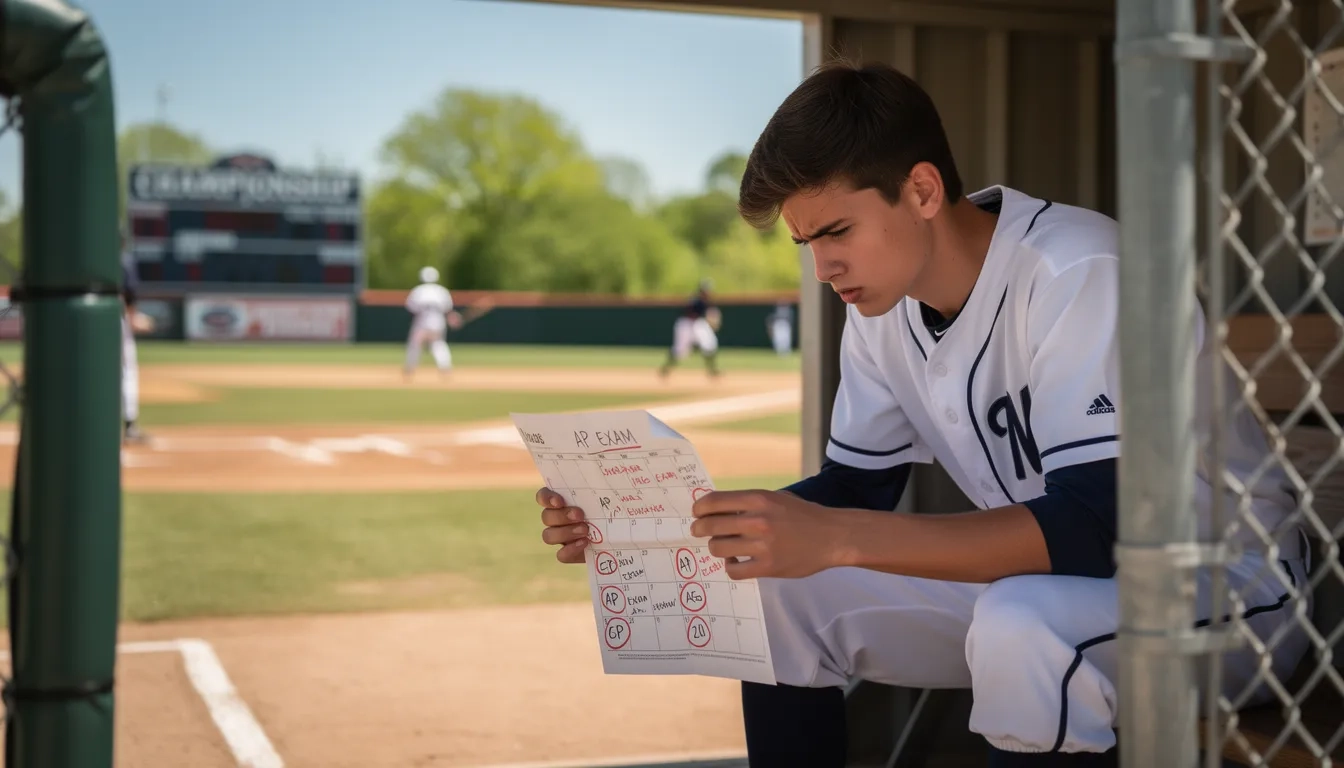
AP exams land in early May. Spring sports seasons peak from late March through May. Nobody designed this collision on purpose, but it hits student athletes every single year — track, lacrosse, baseball, tennis, crew — right in the heart of playoff runs. You're logging 18-hour training weeks and also supposed to be reviewing AP Chemistry stoichiometry. Both have deadlines. Both matter.
Here's what most study guides miss: athletes already have the discipline framework that non-athletes spend months trying to build. Structured schedules, recovery periods, performance under pressure. The translation from training to studying isn't that big a leap. The problem is that most student athletes try to prep for AP exams like non-athletes do, and that's where everything falls apart.
When the Calendar Works Against You
The College Board schedules AP exams across roughly two weeks in May. That window lands squarely inside conference championships for spring sports and, for fall athletes, peak club season before summer recruiting events. Your body needs to peak athletically and your brain needs to peak academically at the same time. Most study advice completely ignores this.
The fix is front-loading prep before your season intensifies. A 12-week study plan starting in mid-February — when winter sports are winding down but spring hasn't hit full stride — gives you space to do content review during calmer weeks and shift to practice exams only once you actually understand the material.
PrepScholar's research-backed AP study framework suggests exactly this sequencing: weeks 1-6 for content review, weeks 7-11 for mixed content and practice tests, and week 12 for final review and rest. For athletes, shift that entire block 2-3 weeks earlier to account for the May sprint.
One thing that's genuinely underappreciated: travel days are not study days. Most athletes who underperform on AP exams aren't unprepared overall. They're underprepared in the two weeks before the exam because an away tournament wiped out their study window and they never rebuilt the buffer.
Mark those travel weekends now. Work around them, not through them.
Strategic Course Loading: Don't Learn This the Hard Way
The single biggest mistake student athletes make with AP courses is clustering them wrong. Taking three or four APs in junior year, right when athletic recruitment intensifies and travel schedules explode, looks manageable in October and catastrophic by March.
Distribute your heaviest AP courses across years. Take one or two in sophomore year. Push lighter courses — AP Human Geography, AP Environmental Science — to years with heavier athletic calendars. Save the demanding ones (AP Calculus BC, AP Chemistry, AP Physics) for a semester when you can genuinely give them attention.
NCAA-bound athletes have an extra layer here. AP courses often count toward NCAA core course requirements, but not automatically. Eligibility rules vary by institution and need confirmation from your school's compliance officer before junior year. Getting this wrong can affect your eligibility. Worth a 20-minute conversation with your counselor well before it matters.
One non-obvious approach: summer content prep. Studying AP course content over the summer before a heavy athletic year means you're reviewing in the fall, not learning. That's a completely different cognitive load going into winter practice season.
Recovery semesters are real, too. If senior spring involves championships travel every other weekend, that's not the semester to add two new APs. This isn't laziness — it's the same periodization logic your coach uses to prevent overtraining.
"Smart course distribution isn't about doing less — it's about doing the right things at the right time of year."
Study Methods That Actually Work When Time Is Tight
Here's where most study guides lose athletes. Recommending "three hours of studying per night" to someone who practices from 3:30-6 PM, eats dinner, showers, and has homework due tomorrow is pure fantasy.
Active recall beats passive re-reading. Testing yourself on a concept — even for 8 minutes before practice — encodes it better than skimming the same page for 40 minutes on a slow Sunday. This is well-documented in cognitive science; the testing effect consistently shows retrieval practice outperforms re-exposure. Flashcards, practice questions, and verbal self-quizzing all count.
Interleaving pairs well with packed schedules. Instead of spending a whole session on one AP subject, mix two or three: 20 minutes of AP History, 15 minutes of AP Calculus, 10 minutes of AP Language. It feels harder. That's the point. Your brain can't go on autopilot, so retention improves.
For session structure, the 40-10 method works better than Pomodoro for tired athletes. Forty minutes of focused work, ten minutes of real rest (not phone scrolling). Repeat twice. That's 80 minutes of genuine studying, which is more than most athletes think they can produce after practice.
Where to find those 80 minutes: morning. A 30-45 minute block before school — flashcards, a set of practice questions — is worth more than the same time at 10 PM when you're depleted.
Building a Weekly Schedule That Survives Contact With Reality
The schedule that looks great on paper and collapses by Tuesday is a cliché because it keeps happening. A workable athlete study plan has two properties: it accounts for energy levels, not just clock hours, and it builds in explicit buffers for travel and hard practice days.
Color-code by category. Red for practice and games. Blue for homework. Green for AP exam prep. Look at your week on Sunday night. If you see no green until Thursday, you can fix that before it becomes a problem.
Here's a realistic weekly structure during AP season:
| Day | Athletic Load | Study Focus | Time |
|---|---|---|---|
| Monday | Light practice | AP content review | 45–60 min |
| Tuesday | Hard practice | Homework only | 30 min |
| Wednesday | Medium practice | AP practice questions | 40 min |
| Thursday | Light practice | AP content review | 45–60 min |
| Friday | Game/competition | Rest | 0 |
| Saturday | Game or recovery | Full practice exam | 90–120 min |
| Sunday | Recovery | Review Saturday's mistakes | 45 min |
The key: Saturday is your AP exam day. One full-length timed practice exam per week, in the 6-8 weeks before the actual test, is as close to a guaranteed score improvement as anything in this guide.
The Communication Play Nobody Makes Until It's Too Late
Coaches already know AP exams exist. They know May is exam month. What they don't know is which specific exams you're taking and when — unless you tell them.
A five-minute conversation with your coach in March can reshape your entire April. Most coaches, given exam dates in advance, will adjust practice intensity or allow you to skip a session before a critical test. Not every coach will. But none of them will if you never mentioned it. Cardinal Education's admissions counselors specifically flag this: the athletes who thrive academically in season are almost always the ones who communicate early, not the ones who disappear during finals week.
Same with teachers. AP teachers see dozens of student athletes every year. Approach them in February — not the week before the exam — and most will point you to the highest-yield review materials, clarify which topics appear most on the exam, and sometimes adjust deadlines around travel. Waiting until you're already overwhelmed is moving the goalposts on your own prep.
Your school counselor is the third player, especially for NCAA-eligible athletes managing course sequencing. A 30-minute planning session in fall, mapping AP schedule against athletic calendar for the next two semesters, is worth more than any single study session.
Sleep and Recovery Are Not Optional
Here's my clear position: sleep matters more than cramming. No hedge.
Student athletes run on a deficit all spring. Practice fatigue is real. Travel is physically exhausting even when you're not competing. Add AP exam anxiety and you have a recipe for a meltdown in the second week of May.
Your brain processes and stores studied information during REM sleep. Cutting sleep for two extra study hours — especially in the final week — reduces retention and slows reaction time. Eight to ten hours isn't a luxury for athletes. It's the mechanism that makes the studying stick.
A 2024 review of adolescent athlete performance data (published in the Journal of Sports Sciences) found that sleep below seven hours produced measurable declines in both cognitive processing speed and working memory capacity. Both matter on an AP exam. Both matter in competition. You cannot separate them.
Nutrition matters too, though not in the complicated way people make it sound. Protein and complex carbohydrates maintain stable energy through study sessions. Skipping lunch to cram during your free period is counterproductive — your focus drops noticeably within 90 minutes on an empty stomach.
The Final Four Weeks: A Countdown That Works
With four weeks left before your first AP exam, here's the sequencing to follow:
- Week 4 out: Identify your weakest units using old AP free-response scoring rubrics. Don't guess — look at what actually cost you points on past class tests or practice FRQs.
- Week 3 out: Targeted content review on those weak areas only. One full untimed practice exam this week to diagnose remaining gaps without the pressure of the clock.
- Week 2 out: One full timed practice exam under actual test conditions. Review every wrong answer before moving on. No new content — only reinforcement of what you've already covered.
- Week 1 out: Light review only. Twenty to 30 minutes per day maximum. Prioritize sleep, nutrition, and — if you have games this week — accept that your mental freshness matters more than another pass through the textbook.
The night before: stop studying by 8 PM. A panicked midnight review session floods working memory with anxiety, not content. The morning of, eat a breakfast with at least 27 grams of protein (eggs, Greek yogurt, a protein shake — something that sustains energy for three-plus hours) and bring water to the testing room.
You've trained for this. The preparation is already in.
Bottom Line
- Start AP prep in mid-February, before spring sports hit full gear — don't wait until April when your schedule is already on fire.
- Distribute AP courses strategically across years; never stack your hardest APs during peak athletic seasons.
- Use active recall and interleaving in short morning sessions rather than long, late-night review blocks. Thirty focused minutes at 6 AM beats ninety exhausted minutes at 11 PM.
- Talk to your coach and AP teachers in March, not May — most will work with you if you communicate early.
- Guard sleep as aggressively as you guard training recovery. The studying you do doesn't stick if your brain doesn't get time to consolidate it.
Frequently Asked Questions
How many hours a week should a student athlete study for AP exams?
Five to seven hours per week, split across four to five sessions, is a realistic and effective target for most student athletes during AP season. That's roughly one to one-and-a-half hours per study day — achievable even around a demanding practice schedule if you front-load the morning hours. Consistency across weeks matters more than cramming a long session before the test.
Is it a myth that student athletes perform worse academically than non-athletes?
Largely yes. Research on student-athlete academic performance consistently shows that athletes tend to develop stronger time management skills than their non-athlete peers — precisely because their schedules force them to become efficient with time. The athletes who do struggle academically typically have scheduling mismatches (too many heavy APs during peak season) rather than a fundamental capacity problem.
Should I skip practice to study for AP exams?
Occasionally, yes — but only if you've talked to your coach first and the exam is within 48 hours. Skipping practice regularly disrupts team dynamics and your own physical conditioning. The better move is adjusting your study schedule weeks in advance so you never face an either/or choice the night before an exam.
What's the single best AP study method for someone with almost no time?
Active recall using flashcards or self-quizzing. It takes as little as 10 minutes, works during commutes or warm-up periods, and outperforms passive re-reading in almost every controlled study on learning and retention. If you only have one method in your toolkit, make it this one.
Do AP courses help with college admissions for athletes?
Yes, and in two ways. AP courses signal academic rigor on your transcript, which matters to admissions officers even when athletic talent is in the picture. For NCAA-bound athletes, AP courses may also satisfy core course requirements — though you'll need to verify which courses qualify with your school counselor and the NCAA Eligibility Center before relying on them.
When should I take my first AP practice exam?
No later than 8 weeks before your actual exam date — and ideally the first one is untimed so you can gauge where you actually stand without the pressure of the clock. Timed, full-length practice exams (simulating real test conditions) should come in weeks 2-4 before the exam once your content review is mostly complete.
Sources
- AP & NCAA Athletes: Balancing Eligibility, Academic Load, and Peak Performance - Sparkl
- How to Balance Sports and Academics for Admissions Success - Cardinal Education
- How to Study for AP Exams: 5-Step Plan - PrepScholar
- How to Practice for AP Exams - College Board
- How to Balance Academics and Sports: 11 Practical Tips - Sacramento Adventist Academy