AP Exam Strategies That Actually Work: A 2026 Practical Guide
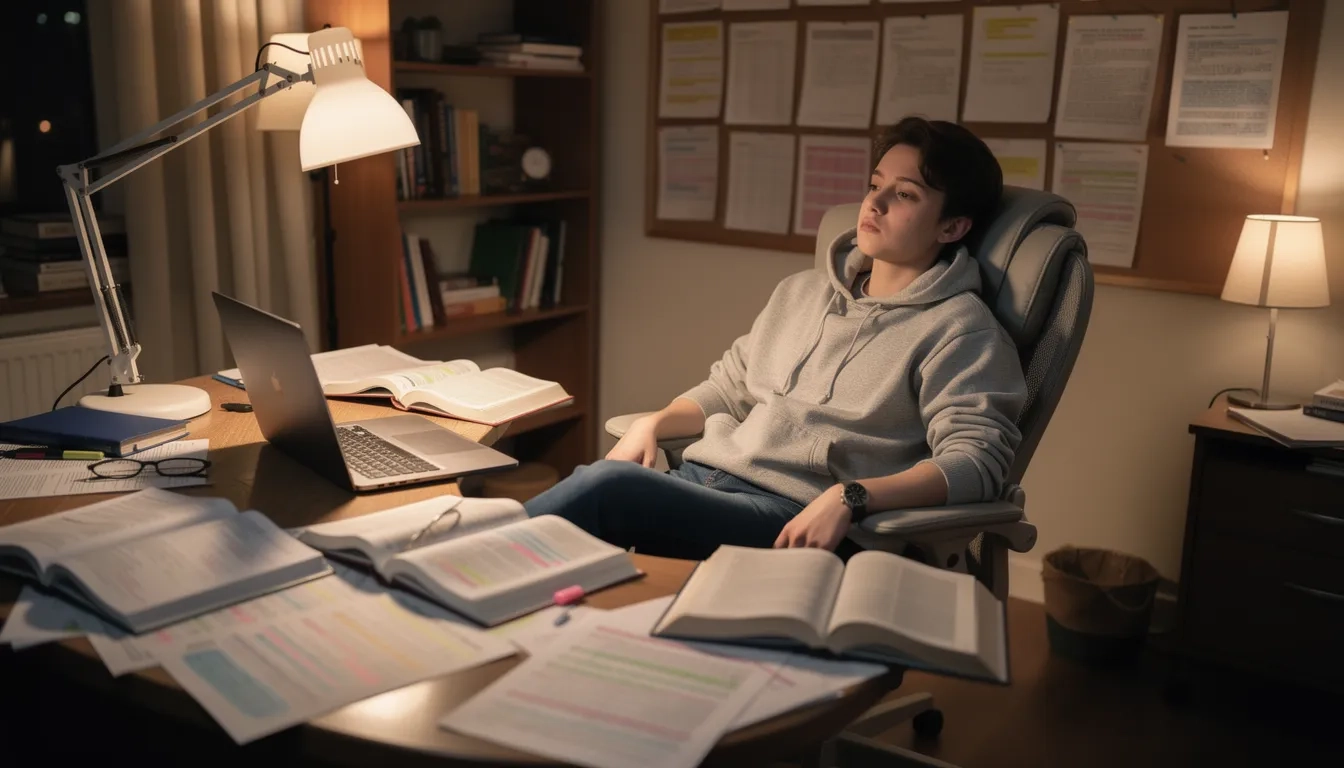
In 2006, Washington University researchers Henry Roediger and Jeffrey Karpicke ran a study that should have changed how every student prepares for standardized exams. Two groups studied the same passage. One group reread it repeatedly. The other tested themselves on it. After one week, the rereading group recalled 34% of the material. The self-testing group recalled 80%. Same passage. Same study time. Wildly different results.
Most AP students are still in the 34% group — not because they're less capable, but because nobody told them their study method was the problem.
The Passive Study Trap
Re-reading feels productive because familiarity mimics understanding. You flip through your notes, recognize the terms, and your brain signals confidence. But AP exams don't test recognition. They test retrieval — pulling information from memory under time pressure with no visual cue to help you.
This gap is sometimes called the fluency illusion. UCLA cognitive scientist Robert Bjork has documented it extensively: students consistently rate themselves as better prepared after rereading than after testing themselves, even when the self-testing group performs dramatically better on actual assessments.
Think about what "studying" typically looks like for AP prep: reviewing highlighted notes, rewatching lecture videos, reading chapter summaries. All recognition activities. None of them build the retrieval pathways the exam actually requires.
The fix is uncomfortable. Testing yourself before you feel ready is harder, more frustrating, and significantly more effective.
Active Recall: Why Testing Yourself Beats Re-Reading
The core principle is simple: force your brain to retrieve information rather than recognize it. Instead of reading a definition, cover it and try to produce it. Instead of reviewing a chapter summary, write out everything you remember about a unit before opening your notes. That effortful struggle is what consolidates memory.
Pair active recall with spaced repetition: returning to material at increasing intervals. Review something today, then in 3 days, then in 7, then in 14. Each review resets the forgetting curve. A comparison study found that students spending three hours on spaced retrieval practice retained 82% of material after one month. Students spending those same three hours re-reading retained 25%.
In practice, this looks like:
- Anki flashcards for vocabulary, formulas, and definitions — but quiz yourself honestly, not passively flipping through cards
- Blank-page dumps: at the start of a study session, write out everything you remember about a topic before looking at anything
- AP Classroom Progress Checks: most students ignore these because they feel like teacher-assigned busywork, but they're mapped directly to the AP exam framework and give genuine diagnostic feedback on specific units
The single most effective AP prep activity in the final six weeks is a full-length, timed practice exam taken under real conditions — not reading, not review videos, not flashcards alone.
Start practice tests when you feel "not ready." That discomfort is exactly the point. The mistakes you make on practice tests are the most valuable information you'll get.
Building Your 4-Week Countdown
Four weeks out from your AP exam, content learning should be mostly finished. If it's not, the strategy still doesn't change — practice beats passive review even when you feel behind, because your brain consolidates faster through doing than through reading.
| Week | Priority | Daily commitment |
|---|---|---|
| Week 1 | Diagnostic practice exam; identify weak units | 60–90 min |
| Week 2 | Targeted review of weak units; practice questions by topic | 60–90 min |
| Week 3 | 1–2 full timed exams; FRQ self-scoring with official rubrics | 90–120 min |
| Week 4 | Light review of remaining gaps; protect sleep above all | 45 min |
Week 1's diagnostic exam is the most important step in the whole plan. Without it, you're allocating study time based on gut instinct, which almost always means over-studying what you already know. Take the full exam, score it honestly, and let the numbers tell you where to go.
Week 4 is where most students derail. Cramming the week before produces minimal gains and real costs. Prefrontal processing — the kind required for multi-step reasoning and analytical writing — degrades on fewer than 7 hours of sleep. Study 45 minutes, then stop. Sleep 8 hours. This is not optional.
If you're taking three or four AP exams in the same two-week window (common for juniors), stagger your Week 3 intensity by subject. Running two exams at full-practice-test intensity simultaneously burns you out before either exam.
Mastering Free Response Questions
FRQs are where students leave the most points behind — not from lack of knowledge, but from not understanding how AP grading actually works.
AP readers grade against a rubric, not an impression. They're not evaluating your analytical voice or the elegance of your argument. They're matching your response against a scoring guide that specifies, sometimes to the phrase level, what triggers a point. A reader might evaluate dozens of responses on a given sub-question in a single sitting. Clarity and directness win. Beautiful prose doesn't.
The key verbs in each prompt matter more than students realize:
- Identify: give a noun or brief phrase — no elaboration required
- Describe: explain what something is or what it does
- Explain: provide a causal chain — X happens because Y
- Justify: evidence plus reasoning, connected explicitly
Miss this distinction and you'll write three sentences when one would have earned the point, or produce a description when a causal explanation was required.
One specific trap worth knowing: contradictory statements cancel each other out. If you write that enzyme activity increases at high temperatures and also that high temperatures denature enzymes, a reader cannot award the point — even though your second statement is correct. They're trained to identify contradictions. Write what you're confident in and leave out what you're not.
Timing discipline matters:
- Long FRQ: 22–25 minutes
- Short FRQ: 10–12 minutes
- Multiple choice: roughly 85 seconds per question
The best free practice resource is AP Central (apcentral.collegeboard.org). College Board publishes past FRQs with scoring rubrics and sample high-scoring responses going back more than a decade. Read those samples carefully. Notice what earns points and what doesn't. Then write practice responses, score them with the actual rubric, and pinpoint exactly where you lost credit.
AP Pass Rates in 2026: What the Data Says
Pass rates vary dramatically across AP subjects. Here's 2025 data, which reflects the landscape going into 2026 testing:
| Exam | Pass rate (3+) | Scored a 5 |
|---|---|---|
| AP Research | 89% | 15% |
| AP Chinese Language | 88% | 51% |
| AP Seminar | 86% | 10% |
| AP Precalculus | 81% | 28% |
| AP Calculus BC | 80%+ | 44% |
| AP Calculus AB | 64% | 20% |
| AP Statistics | 60% | 17% |
| AP Latin | 59% | 13% |
AP Calculus BC's 44% five-rate looks remarkable, but don't misread it. The student pool taking BC skews heavily toward students who've already excelled in advanced math. That high five-rate reflects who's sitting in the room, not an easier exam.
Here's the more strategically useful data point: the Fordham Institute documented that College Board has recalibrated nine AP exams since 2022, resulting in roughly 500,000 additional passing scores in a single year. AP U.S. Government had a near-complete inversion — a distribution that previously centered on scores of 1 to 3 now centers on 3 to 5. AP Physics 1 went from a 47% pass rate in 2024 to 66% in 2025. A 19-point swing in one year. Students didn't suddenly get smarter.
College Board frames this as improving alignment between AP scores and actual college performance (which is their stated goal through Evidence-Based Standard Setting). Fordham raises the question of whether commercial pressures — AP generates roughly $500 million annually and competes directly with dual-enrollment programs — influenced the recalibration timeline. My read: both things are probably true, and neither changes the practical advice. Some AP exams that carry tough reputations are now more achievable than that reputation suggests. Check the most recent pass rate data for your specific exam before deciding how hard to push.
Test Day Execution
You've prepared. Now the job is execution without self-sabotage.
Multiple choice is about elimination, not certainty. You won't know every answer. The strategy isn't to guess randomly — it's to eliminate the options you know are wrong, then make the most defensible call from what's left. Mark uncertain questions, move on, return at the end. Spending 4 minutes on one question you can't solve is one of the most expensive decisions you can make on a timed exam.
Bluebook logistics matter in 2026. Most AP exams now run through College Board's Bluebook digital testing app. Download it months in advance and complete the practice previews. The annotation tools and interface work slightly differently than paper, and fumbling with a digital flag button during an actual exam wastes real time.
The night before: eat a normal dinner, don't study, sleep 8 hours. The morning of: eat a real breakfast (your brain runs on glucose and you're asking it to perform for 3+ hours under pressure). When you sit down, read the section directions even if you've seen them a dozen times. AP exam formats in 2026 include updated section structures on several tests that differ from pre-2025 versions. Two minutes of careful reading can prevent a structural mistake on the FRQ that costs you multiple points.
Bottom Line
The gap between students who score a 3 and those who score a 5 is usually method, not raw ability. Most students study passively and wonder why they plateau.
Here's what actually works:
- Switch to retrieval practice: practice tests, blank-page recall, and self-quizzing over re-reading
- Take a full diagnostic exam first: let the data tell you where to focus, not your gut
- Learn how FRQ rubrics work: read past scoring guides on AP Central and practice scoring your own responses
- Protect Week 4: light review and 8 hours of sleep beats cramming every time
- Check current pass rates for your specific exam: the difficulty landscape shifted meaningfully between 2024 and 2025
The best time to start this was eight weeks ago. The second-best time is today.
Frequently Asked Questions
How many AP exams should I take at once?
There's no universal answer, but most college counselors suggest 3–5 AP courses total in junior and senior year combined, not per semester. Taking 6–7 simultaneously usually produces lower scores across all of them rather than impressive breadth. Depth — a 5 in three subjects — tends to read better than mediocrity across seven.
Is it worth taking an AP exam if I'm not confident I'll pass?
Generally yes, with one caveat. A score of 1 or 2 doesn't hurt your GPA and doesn't appear on college applications (you choose which scores to send). So the downside is just the exam fee (around $98 per exam in 2026 without fee reductions). If there's any realistic shot at a 3, it's usually worth attempting.
Is cramming the week before really that bad?
Yes, and the research is unambiguous on this. Cramming can boost performance on the very next day, but it produces almost no retention beyond 72 hours. For AP exams — which require synthesis, application, and analytical writing, not just memorized facts — last-minute cramming actually tends to produce worse FRQ responses because it crowds out sleep, which consolidates memory. Stop heavy studying by the Thursday before your exam.
What's the biggest misconception about FRQ scoring?
That length equals points. AP readers are matching your response against a rubric checklist. A precise two-sentence answer that hits the required causal chain will outscore a rambling two-paragraph response that buries the same claim in vague language. Longer answers also create more opportunities to accidentally write a contradictory statement, which can cost you a point you would have otherwise earned.
How do I use AP Central's past exams effectively?
Don't just answer the questions — score them. Download the scoring rubric alongside the past FRQ, write your response under timed conditions, then grade it yourself using the rubric, exactly as a reader would. Most students skip this step and learn nothing from their practice sessions. The scoring is where the real feedback lives.
Sources
- 2026 AP Exam Schedule & Pass Rates by Subject - Ivy-Way
- The Great Recalibration of AP Exams - Fordham Institute
- Score Setting and Scoring – AP Central | College Board
- Practice Tests, Spaced Practice, and Successive Relearning - APA
- AP Biology FRQ Tips — How to Score Full Points
- AP Exams Are Coming: How to Create a Winning Study Plan - Tutor Doctor