AP Latin Study Guide: How to Prepare for the 2026 Exam
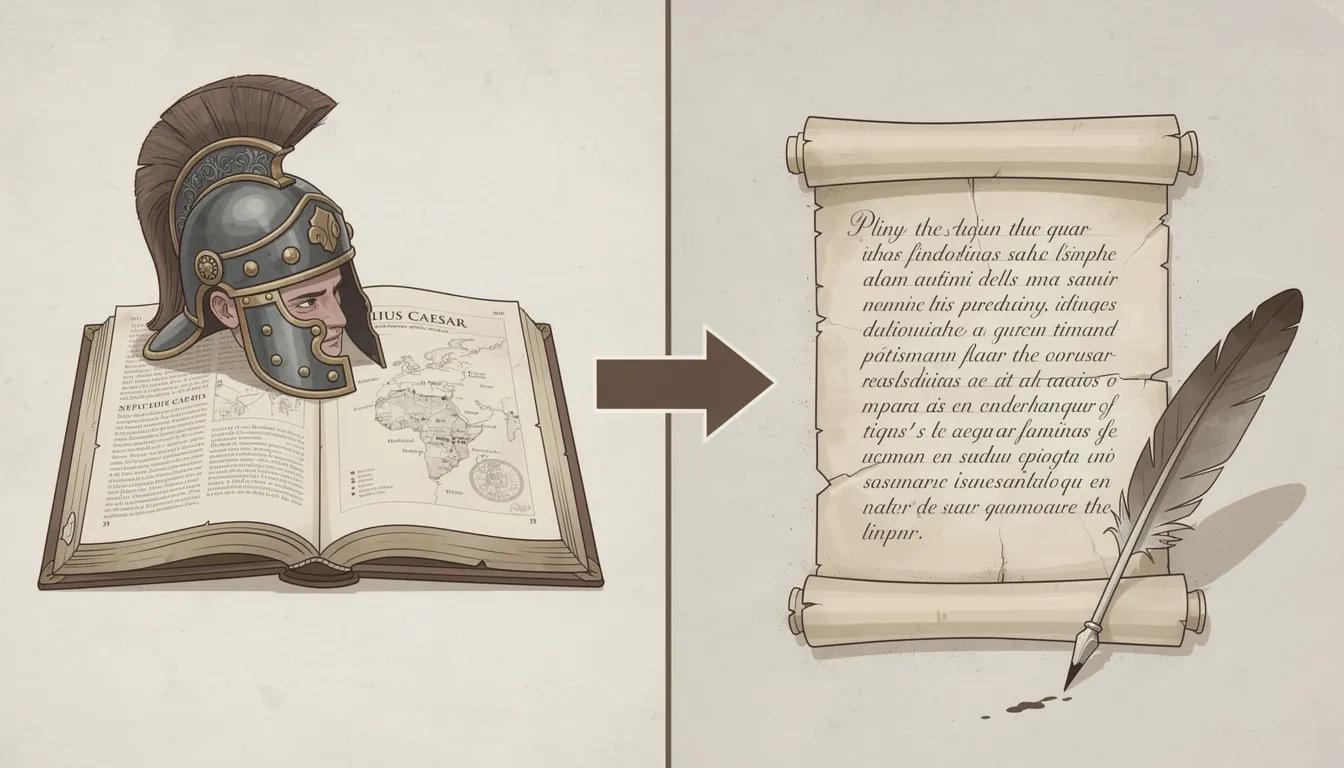
On May 4, 2026, AP Latin students across the country will open Bluebook and face an exam that looks meaningfully different from what their older siblings took. Caesar is gone. Pliny the Younger is in. The analytical essay has been replaced by shorter, more targeted writing tasks. And the whole thing is now digital.
If you've been preparing with old study guides, some of that prep may be pulling you in the wrong direction. The curriculum overhaul that took effect for the 2025-26 school year is the biggest restructuring since 2012, and understanding exactly what changed — and why — is the first step toward scoring well.
What Changed for 2026 (and Why It Matters)
The most talked-about change: Caesar's Gallic War is out, replaced by Pliny the Younger's Letters. The College Board reduced the total number of units from 8 to 6, cut roughly 6,000 words from the required reading list, and consolidated the five skill categories into three.
There's also a new course project component that contributes 2% of your final score. Students analyze four non-syllabus passages (two at each in-class checkpoint), write summaries, and present interpretations backed by textual evidence. These project passages then appear on the actual exam — which we'll cover below.
Vergil's Aeneid stays at the center of the course, but the book selections expanded. Books 7, 11, and 12 are now included alongside the traditional Books 1, 2, 4, and 6. That's a meaningful addition — the battle narratives in those later books test different vocabulary and constructions than the famous opening episodes.
Why did the College Board make these changes? According to their published course revision documentation, Pliny offers more approachable prose for students while still covering the breadth of Roman literary culture. He was a near-contemporary of Tacitus but writes in epistolary form — shorter, conversational, and rich with social context that supports analysis questions better than Caesar's military commentary.
The 2026 AP Latin Exam: A Format Breakdown
The exam is fully digital, administered through College Board's Bluebook platform — the same system used for the digital SAT. The old 15-minute reading period has been removed.
Here's how the exam divides:
| Section | Time | Weight | Questions |
|---|---|---|---|
| Section I: Multiple Choice | 1 hr 5 min | 50% | 52 questions |
| Section II: Free Response | 1 hr 55 min | 50% | 5 questions |
| Course Project Checkpoints | In-class | 2% | — |
Section I (MCQ) breaks into four question types:
- 20 questions on discrete sight passages
- 6 questions on short sight passage sets
- 6 questions on short syllabus passage sets
- 20 questions on long syllabus passage sets
Section II (FRQ) includes five questions:
- Short answer with 6-8 subquestions
- Translation across 15 segments
- Short essay with 2 subquestions
- Project prose passage essay (2 subquestions)
- Project poetry passage essay (2 subquestions)
The old analytical essay — once the heaviest single free-response component — is gone, replaced by shorter, more targeted writing. That's genuinely good news for students who knew their Latin well but struggled with essay structure under time pressure.
Mastering the Texts: Vergil's Aeneid
Vergil is still the heart of AP Latin. A substantial portion of your syllabus passage questions pull from the Aeneid, and you need to know the selected books with real depth — not just translation, but the ability to analyze specific lines on demand.
The biggest skill gap among students working on Vergil isn't vocabulary or even translation accuracy — it's meter. Dactylic hexameter scansion questions appear in the MCQ section and trip up students who learned the theory but never built the reflex. The pattern is long-short-short or long-long (dactyl or spondee), with the last foot always a long-long or long-short. Practice scanning out loud. Your ear can learn the rhythm faster than your eye can count syllables.
For analysis questions, the framework that earns full credit is: identify the device, state its effect, then connect it to meaning. Not "Vergil uses alliteration here" but "the repeated hard /c/ sounds in caelo tonat create a percussive rhythm that reinforces Jupiter's commanding authority." Specificity is what separates partial credit from full credit.
Key Aeneid moments to know cold:
- The storm in Book 1 and Juno's driving anger
- Dido's death in Book 4 (the emotional and rhetorical apex of the selections)
- The descent to the Underworld in Book 6 and Anchises' vision of Roman destiny
- Battle scenes from Books 7, 11, and 12 — new to the 2026 curriculum
Mastering the Texts: Pliny the Younger
Here's where students new to the 2026 curriculum need to recalibrate. Pliny's Latin is different from Vergil's in ways that matter for exam performance.
Pliny writes in epistolary prose: structured, polished sentences meant to look casual. His letters to the Emperor Trajan, to his young wife Calpurnia, and his famous eyewitness account of Mount Vesuvius's eruption in 79 CE (Epistulae 6.16 and 6.20) are all in the 2026 curriculum. That eruption letter is one of the most detailed first-person descriptions of a natural disaster in ancient literature — and it tests differently than Vergil because context and tone matter as much as grammar.
When reading Pliny, track these three things:
- Tone: formal or intimate? Deferential or confident? Pliny shifts register deliberately between different correspondents.
- Audience: letters to Trajan are political and require careful courtly framing; letters to Calpurnia are personal and warm. The same Latin construction can signal different things depending on who's receiving it.
- Cultural context: The Vesuvius letters require knowing that Pliny the Elder (Gaius Plinius Secundus) died in the eruption. That biographical detail informs every word of his nephew's account.
The main mistake students make with Pliny: applying Vergil-style literary analysis — imagery, sound patterns, meter — to prose passages where the analytical frame should focus on rhetoric, epistolary conventions, and social dynamics instead.
The Grammar You Actually Need
You probably studied every form in the Latin paradigm tables at some point. For this exam, certain constructions carry far more weight than others.
The high-frequency constructions to know cold:
- Ablative absolute: A noun plus participle in the ablative case forming a subordinate clause ("the city having been captured..."). These appear constantly in both Vergil and Pliny.
- Indirect statement (accusative + infinitive): Dominant after verbs of saying, thinking, and knowing. Know how to identify the subject, distinguish tense from the main verb, and translate the infinitive correctly.
- Subjunctive clauses: Purpose (ut + subjunctive = "so that"), result (ut + subjunctive + signal word like tam or ita = "so that...he..."), indirect command, and cum clauses (temporal, causal, concessive). The subjunctive has four main jobs in this exam and mixing them up costs real points.
- Relative clauses: Especially "connecting" relative clauses that substitute for a demonstrative pronoun. Students miss these because they look for a clear antecedent that isn't there.
- Participles: Active, passive, perfect, and future. The future passive participle (the gerundive) also functions in obligation constructions (mihi faciendum est = "it must be done by me"). Know all five forms and functions.
A practical drill that actually works: take any paragraph from Pliny and label every grammatical construction before translating. No guessing allowed. Label first, translate second. That discipline is what turns "I kind of know what this says" into "I can defend every word choice."
Scoring Strategy and Time Management
In 2024, 56.5% of AP Latin students earned a 3 or higher — among the lower pass rates across all AP exams that year. The mean score was 2.77. In 2025, the mean edged up to 2.84 with a 58.6% pass rate. Scoring a 5 generally requires hitting around 72% of the composite, while a 3 needs roughly 42%. Those numbers make clear this exam demands real preparation.
For the MCQ section (1 hour 5 minutes, 52 questions):
That's about 75 seconds per question. Sight passage questions run slower — budget 90 to 120 seconds on each passage-based question and use the remaining time to answer easy syllabus questions quickly. Process of elimination is underrated here. Latin MCQ wrong answers are usually tempting because they pull from the same semantic field as the correct answer. Slow down when something "looks right."
The translation question is the single most recoverable free-response component. Fifteen segments, each worth the same fractional credit. If you hit a hard stretch, write what you can, flag it, and move on — coming back with fresh eyes often unlocks the word that wouldn't come.
For the FRQ section (1 hour 55 minutes), a rough time budget:
- Translation: 20-25 minutes
- Short answer sets: 15 minutes each
- Project passage essays: 20 minutes each
The project passage essays are new this year and feel unfamiliar to many students. The good news: you analyzed these passages during your in-class checkpoints, so the material isn't cold. Treat them as an opportunity to show the analytical moves you've practiced — device, effect, meaning.
One underrated timing note: type faster. The digital format means your essay output is partly a typing-speed problem. If you normally think in longhand, doing a few practice FRQs on a keyboard before exam day is worth more than 47 minutes of flashcard review.
Bottom Line
- Know that the curriculum changed. Old Caesar prep doesn't transfer to Pliny. Start your Pliny reading with Epistulae 6.16 — the Vesuvius letter — because it appears frequently in practice materials and tests both translation and cultural analysis simultaneously.
- Drill the five core constructions: ablative absolute, indirect statement, subjunctive (purpose, result, cum clauses), relative clauses, and participles. Everything else in Latin grammar builds on these.
- Practice timed sight reading every week. The sight-passage MCQ questions are roughly a third of your multiple-choice score. You cannot prep them by re-reading the syllabus texts.
- Don't underestimate the course project. The two in-class checkpoints feel low-stakes, but the project passage essays appear on the actual exam — familiarity with those passages is essentially free points.
- Type out your practice FRQs. The exam is digital. Build the keyboard habit before exam day.
Frequently Asked Questions
Is AP Latin one of the harder AP exams?
By pass rate, yes. The 2024 pass rate of 56.5% (scores of 3 or higher) was lower than most other AP exams that year, and the 2025 mean of 2.84 reflects a genuinely demanding test. That said, students with strong Latin foundations who practice timed sight reading consistently tend to score well above the average.
What happens to students who took AP Latin before the 2025-26 revision?
The new curriculum only affects students sitting for the May 2026 exam and beyond. If you took the exam in 2024 or earlier, you were tested on Caesar. Practice materials from before 2025 are still useful for Vergil prep but will have outdated prose questions — don't use them for Pliny work.
Do I need to memorize Pliny's letters word for word?
No, but you need deep familiarity with the key letters — especially the Vesuvius correspondence (Epistulae 6.16 and 6.20) and the letters to Trajan and Calpurnia. The exam asks you to analyze specific lines, which requires knowing the surrounding context even when the passage is reproduced on screen in front of you.
How is the course project graded, and does it actually matter?
Your teacher submits checkpoint scores that count for 2% of your final AP score. That's small but not nothing — on a borderline score, 2% can flip the final grade. More practically, the passages you analyze during checkpoints reappear on the exam as project essays. The project is also hidden prep.
What's the best way to improve at sight translation?
Read Latin you haven't seen before, under time pressure, regularly. The Bolchazy-Carducci reader for AP Latin (updated for the 2025-26 curriculum) includes practice sight passages calibrated to exam difficulty. Two to three timed sight passages per week for the three months before the exam is a realistic schedule for most students.
Should I take AP Latin if I plan to study a modern language in college?
Honestly, yes — if you have the grammar foundation. Latin trains you to read analytically in ways that transfer directly to French, Italian, Spanish, and even German. Many colleges also offer credit or placement from an AP Latin score of 3 or higher, which can free up a course requirement regardless of your major.