AP Physics 1 Study Guide: How to Score a 4 or 5 in 2026
The numbers shifted almost overnight. In 2024, only 47% of AP Physics 1 students passed with a 3 or higher — one of the worst pass rates among all AP exams. Then the College Board redesigned the exam for 2025, and that figure jumped to 67%. The score-5 rate nearly doubled, from 10% to about 20%. If you're sitting for the 2026 exam on May 6, that context matters: the test is more learnable than its reputation suggests, but only if you know exactly what changed and where to focus.
What the Exam Actually Looks Like Now
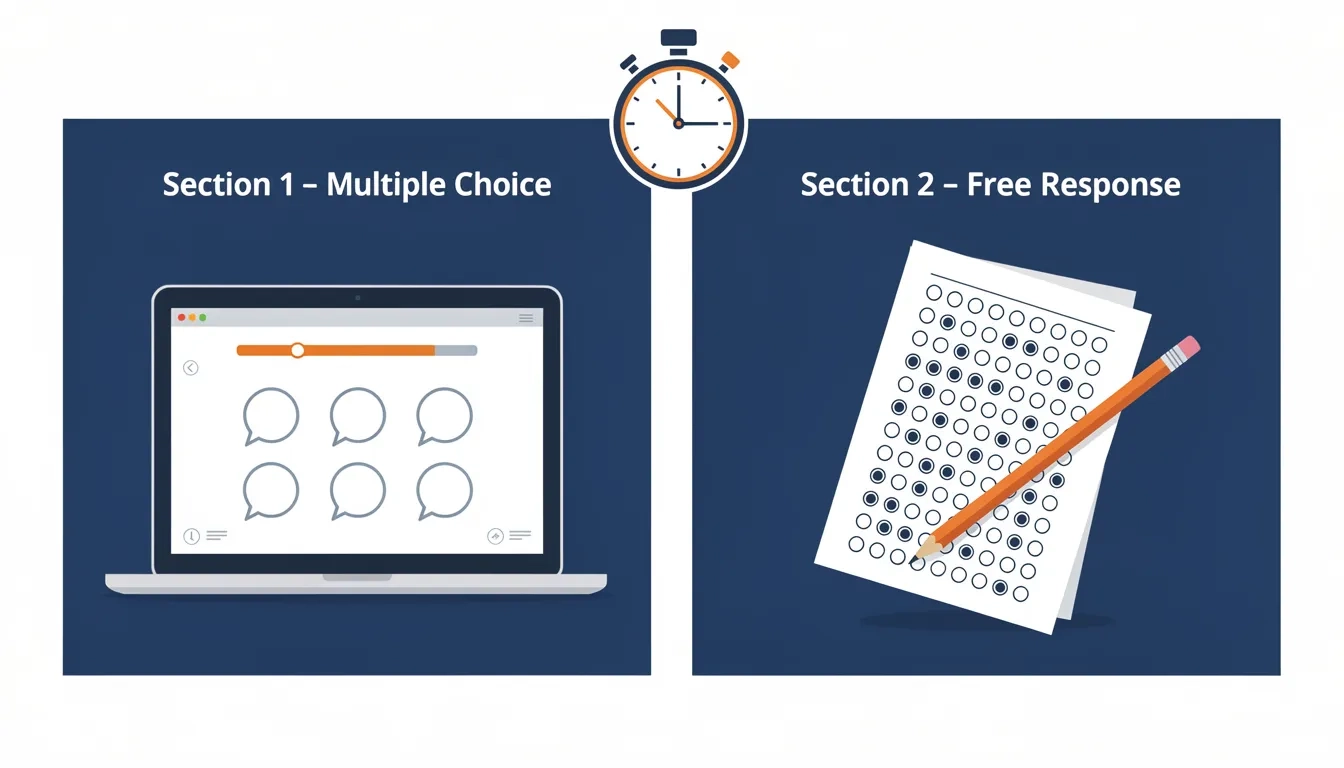
The AP Physics 1 exam got a significant overhaul starting in 2025. It's now a hybrid digital/paper format: you answer multiple-choice questions in the College Board's Bluebook app on a tablet or laptop, then handwrite your free-response answers on paper booklets. Two separate interfaces on exam day. If that's new information to you, it's worth knowing before you walk in.
Here's the current structure:
| Section | Questions | Time | Score Weight |
|---|---|---|---|
| Multiple Choice | 40 questions | 80 minutes | 50% |
| Free Response | 4 questions | 100 minutes | 50% |
Two minutes per multiple-choice question. Twenty-five minutes per free-response. That's more breathing room than the old format offered — 50 MCQs in 90 minutes and 5 FRQs in 90 minutes — and it shows in the score improvements.
The multi-select questions are gone entirely. The old exam required picking two correct answers on some MCQs, which punished partial guesses. The new format uses single-answer questions with four choices instead of five. Less ambiguity, more focus on actual understanding.
One development that catches students off guard: fluids moved from AP Physics 2 into Physics 1. Fluid pressure, buoyancy, and the continuity equation now make up 10–15% of your exam score. If you're using prep materials from before 2024, this content simply won't be there. Old books are a trap for this exam.
How Scoring Works (and Why Partial Credit Matters)
Each section contributes equally to your final score. The raw points from both sections combine into a composite that maps to the 1–5 scale.
The exact cutoff scores shift slightly year to year based on exam difficulty. But historically, earning roughly 65–70% of available points gets you a 3, and around 80% or higher gets you to a 5.
Partial credit on FRQs is substantial, not symbolic. A student who sets up the problem correctly, shows clear reasoning, but makes an arithmetic error halfway through can still earn most of the points for that question. The rubric scores reasoning separately from computation. This is why showing your work isn't optional — it's where points live.
The score distributions across AP Physics exams reveal something worth knowing:
| Exam | Pass Rate (3+) | Score-5 Rate |
|---|---|---|
| AP Physics 1 | ~67% (2025) | ~20% |
| AP Physics 2 | ~70.5% | ~19% |
| Physics C: Mechanics | ~76.3% | ~28.5% |
| Physics C: E&M | ~71.6% | 35.2% |
Physics C students tend to be taking calculus simultaneously, which builds mathematical fluency. But AP Physics 1's improving numbers suggest the redesigned exam rewards the kind of conceptual preparation that's genuinely teachable — which is good news for anyone willing to put in structured work.
Where to Spend Your Study Time
Not all topics are worth equal attention. The College Board publishes unit weights, and the math is blunt: two units alone account for roughly 41% of your exam score.
| Unit | Topic | Exam Weight |
|---|---|---|
| Unit 2 | Force and Translational Dynamics | 18–23% |
| Unit 3 | Work, Energy, and Power | 18–23% |
| Unit 8 | Fluids | 10–15% |
| Unit 5 | Momentum | 12–18% |
| Unit 6 | Torque and Rotational Motion | 12–18% |
| Units 1, 7, 9 | Kinematics, Oscillations, Waves | remainder |
Get Units 2 and 3 solid before touching anything else. If Newton's laws and the work-energy theorem aren't second nature, every downstream topic gets harder than it needs to be.
Fluids is the sleeper topic of this exam. Most prep materials and teachers skipped it entirely before 2024 because it lived in Physics 2. It's now non-negotiable — and students who treat it as optional are handing away a chunk of their score.
Simple harmonic motion and circular motion carry lower weights (around 4–8% each), but they tend to show up in FRQs in combination with other topics. Don't skip them — just don't let them crowd out your core mechanics preparation.
The Free-Response Section Is Where Scores Diverge
The four FRQ types on the current exam each require a distinct approach. Treating them all the same is how students underprepare.
- Mathematical Routines — Multi-step calculation problems. Show every step explicitly. The grader follows your reasoning, not just your final answer.
- Translation Between Representations — Convert between graphs, equations, and written descriptions. A common version: sketch a velocity-time graph from a verbal motion description, then write the matching kinematic equation.
- Experimental Design and Analysis — Design a procedure to measure a physical quantity, identify variables, and interpret data. This draws directly on lab experience.
- Qualitative/Quantitative Translation — Explain in words why a mathematical result makes physical sense, or derive what should happen qualitatively from a given equation.
The most common FRQ mistake is omitting the physical explanation. A student solves the equation, gets the right number, writes nothing about what it means — and drops justification points that had nothing to do with arithmetic. The rubric explicitly credits reasoning. Write it down.
For experimental design questions, College Board expects you to distinguish controlled variables from independent variables and name realistic sources of systematic error. These are lab skills. If your class did hands-on experiments, that work is paying off right now more than you might realize.
A Study Plan That Doesn't Waste Time
Here's a structure that works over 11 weeks, running backward from the May 6 exam date:
Weeks 1–3: Build the foundation. Cover kinematics and Units 2–3 deeply. Aim for 15–20 practice problems per session — not for speed yet, but for genuine comprehension. Draw a free body diagram for every single force problem, including the ones that seem obvious.
Weeks 4–6: Expand into fluids, momentum, and rotation. Fluids makes more intuitive sense once you understand pressure as force per unit area. Use only 2025–2026 College Board practice materials here — older resources won't reflect the current content or FRQ format.
Weeks 7–9: Full-length practice tests under real conditions. Time yourself. Use the Bluebook app for the MCQ section so the interface isn't unfamiliar on exam day. Handwrite FRQ answers on paper, exactly as you will during the actual exam. Review every wrong answer before moving to the next test.
Weeks 10–11: Target weak FRQ types and do formula review in context. By now you know which question types cost you points. Write out full FRQ responses and self-grade using College Board's released rubrics (they're publicly available on AP Central). This is more useful than any third-party answer key.
One thing a lot of guides get wrong: they suggest "reviewing formulas" as a final step. Formulas without context barely help on this exam. Instead, practice explaining what each formula describes physically — that's exactly what the qualitative/quantitative FRQ type tests.
Mistakes That Kill Scores (and How to Avoid Them)
These patterns show up constantly in student work:
- Skipping free body diagrams. Force problems done without FBDs lead to missed forces, sign errors, and wrong directions. Draw them every time.
- Using pre-2024 prep books. The content changed. Fluids is new. Multi-select questions are gone. Old materials misrepresent both the content distribution and the exam format.
- Never practicing with the Bluebook app. The MCQ section runs on this interface. Download it and do at least one full practice session before exam day — unfamiliar software costs time.
- Writing answers without units. A correct number with no unit earns zero credit on FRQs. This is a mechanical mistake that has nothing to do with understanding physics.
- Rushing multiple choice. With 2 minutes per question, you have room to think carefully. Students who speed through often make careless errors and still finish early — wasting points for no reason.
The time allocation on FRQs surprises most students. One hundred minutes for four questions means 25 minutes each. That's more than enough to reason through, write clearly, and still finish — if you've practiced writing timed FRQ responses beforehand. Students who've never done this under the clock tend to underwrite their answers and leave scoring opportunities on the table.
Conceptual Understanding vs. Calculation Fluency
There's a running debate among AP Physics teachers about which deserves more study emphasis. The exam has basically answered this question.
Conceptual reasoning is the core competency the redesigned exam tests. The qualitative/quantitative translation FRQ type exists specifically because College Board wants to know whether you understand physics — not just whether you can plug numbers into a given equation. The wrong-answer choices on MCQs are carefully designed to catch students who have the formula right but the concept wrong.
That said, you can't skip computation entirely. Mathematical Routine FRQs require clean, step-by-step algebraic work. The right balance: for every formula you work with, spend equal time understanding what physical scenario it describes and what happens to the output when each variable changes. That's the habit that separates students who score 4s from those who score 5s. The 4-scorers can do the math. The 5-scorers can also tell you why the math gives the answer it does.
Bottom Line
- Units 2 and 3 are nearly half the exam — get forces and energy locked down before everything else.
- Fluids is no longer optional. It accounts for 10–15% of your score and won't appear in any pre-2024 prep materials.
- FRQ explanations earn points on their own, separate from computation. Show your reasoning in writing even when you're confident about the numbers.
- Practice the Bluebook app interface before exam day, and write timed full FRQ responses that you self-grade using College Board's published rubrics.
- The 2025 redesign shifted the exam toward rewarding genuine understanding. That means preparation strategy should center on comprehension — not formula memorization.
Frequently Asked Questions
Is AP Physics 1 harder than AP Chemistry or AP Biology?
By raw pass rates, AP Physics 1 historically sits among the more difficult AP exams, though the 2025 redesign improved outcomes noticeably. The challenge isn't necessarily more content — it's that the exam penalizes rote memorization harder than most AP science tests do. Students who understand the reasoning behind formulas outperform those who don't, often by a full score point.
What score do I need to get college credit?
It depends on the university. Most schools that award credit for AP Physics 1 require a 3 or 4. Selective schools — MIT, Caltech, most Ivy League programs — typically require a 4 or 5, and some only accept Physics C credit, not Physics 1 at all. Check each school's AP credit policy before assuming a 3 will transfer into a course waiver.
Can I self-study AP Physics 1 without taking the class?
Yes, but it takes more discipline than most self-study AP exams. The experimental design FRQ type draws on lab skills that are hard to build through reading alone. If you're self-studying, Khan Academy's AP Physics 1 course (free and aligned to the College Board curriculum) is a solid starting point, supplemented with practice problems from Albert.io. Budget at least 150–180 hours of preparation — possibly more if you're coming in without a strong algebra background.
Does the fluids unit require calculus?
No. AP Physics 1 is algebra-based throughout, including fluids. The key concepts are fluid pressure (P = ρgh), Archimedes' principle for buoyancy, and the continuity equation (A₁v₁ = A₂v₂). Calculus-based physics lives in AP Physics C, which is a separate set of exams entirely.
What's the difference between AP Physics 1 and AP Physics C?
AP Physics 1 is algebra-based and covers mechanics, fluids, waves, and circuits at an introductory level. AP Physics C splits into two calculus-based exams: Mechanics, and Electricity and Magnetism. Physics C is typically taken by students with concurrent calculus coursework, and it's more broadly accepted for credit at selective universities. Physics C: E&M's 35.2% score-5 rate reflects a self-selected, mathematically prepared population — it's not inherently easier than Physics 1.
How should I approach multiple-choice questions I'm unsure about?
There's no guessing penalty on AP exams, so answer every question. When stuck, start by eliminating options that violate basic physical principles — energy conservation, Newton's laws, dimensional consistency. That usually narrows four choices down to two. Budget no more than 2 minutes per question; if you're going past that, mark it and move on. Return with fresh eyes at the end.