AP World History: Complete Study Guide and Score Tips
The AP World History exam has a dirty secret most students don't figure out until they're sitting in the exam room: essays account for 60% of your final score. Not 40%. Not half. Sixty. Yet the average student spends most of their prep time memorizing dates and empires. That mismatch explains why capable students walk out with a 3 when they could have had a 5.
What the Exam Actually Looks Like
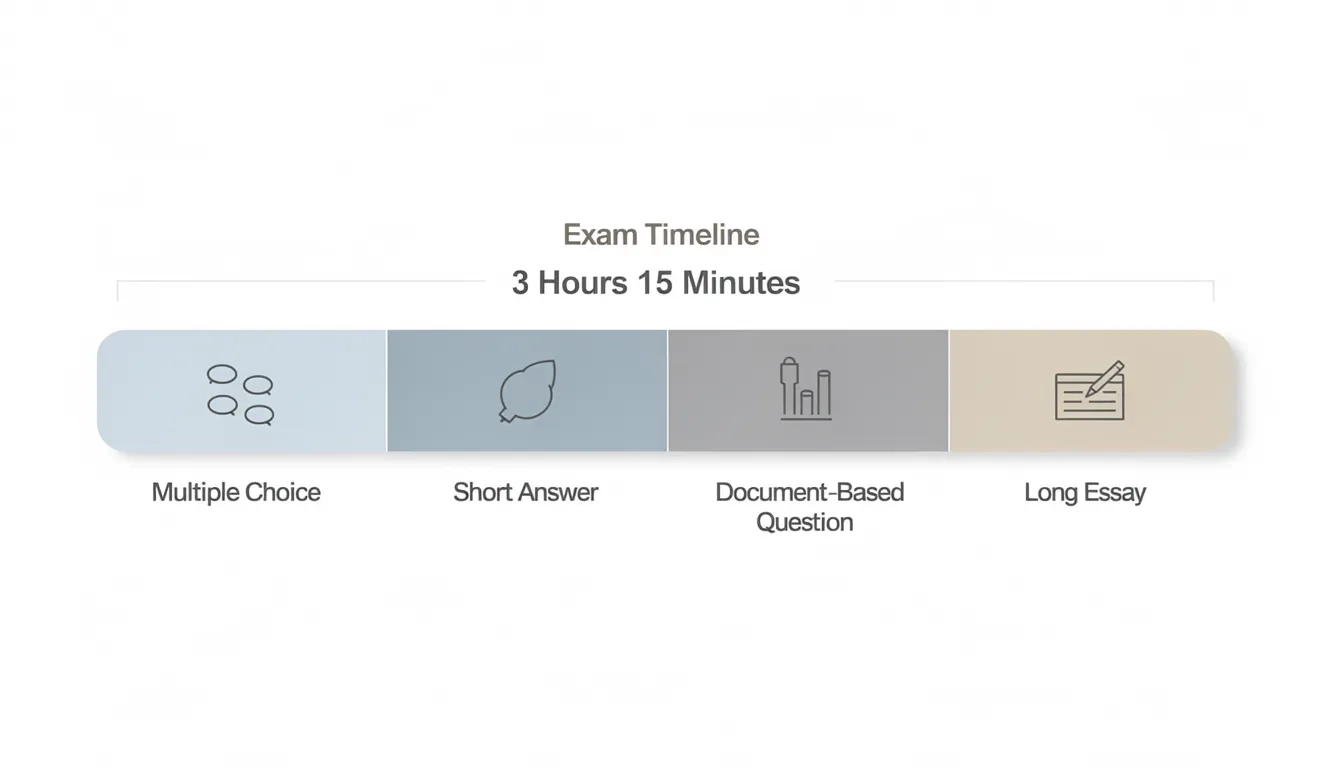
The full exam runs 3 hours and 15 minutes, plus a mandatory 15-minute reading period for the essay section. Here's how every minute breaks down:
| Section | What You're Doing | Time | Score Weight |
|---|---|---|---|
| I-A | 55 Multiple Choice Questions | 55 minutes | 40% |
| I-B | 3 Short Answer Questions (SAQs) | 40 minutes | 20% |
| II-A | Document-Based Question (DBQ) | 60 min + 15 min reading | 25% |
| II-B | Long Essay Question (LEQ) | 40 minutes | 15% |
The essays collectively outweigh everything else. DBQ + LEQ + SAQ together = 60% of your grade. If your prep plan leans heavily on content review and light on essay practice, you're working against the math.
The multiple-choice questions span c. 1200 CE to the present, clustered in sets of 3–4 around a shared stimulus (a document excerpt, map, graph, or image). You have roughly one minute per question—not a lot of time to second-guess yourself.
The Unit Weighting Game
AP World History covers nine units. They are not weighted equally, and treating them as if they are will cost you.
Units 3 through 6 (roughly 1450–1900) are the core of the exam. Each accounts for 12–15% of the multiple-choice section, which means together they can represent up to 60% of MCQ coverage. The Columbian Exchange, Atlantic slave trade, rise of land-based empires, and Industrial Revolution are not optional topics.
Units 7–9 (1900 to the present) are where students get careless. Because they feel "too recent," people deprioritize them. That's a mistake. Cold War dynamics, decolonization, and globalization show up in essays with surprising frequency.
Unit emphasis at a glance:
- Units 1–2 (1200–1450): 8–10% each — medieval trade networks, Mongol expansion, Swahili Coast
- Units 3–6 (1450–1900): 12–15% each — the high-priority zone
- Units 7–9 (1900–2001): 8–10% each — don't skip these for essay prompts
Spend roughly half your content-review time on Units 3–6. Treat the rest as context-builders and essay-insurance.
Multiple Choice: Speed Without Sacrifice
Fifty-five questions in fifty-five minutes sounds brutal. It doesn't have to be.
Most MCQ sets are built around a stimulus that contains most of what you need to answer the questions. Read the source before the questions—30 focused seconds on the document often unlocks 3 answers in under 2 minutes. Students who skip the stimulus and go straight to the questions end up re-reading it anyway, just less efficiently.
The most common MCQ trap is Eurocentric thinking. The College Board designs questions specifically to test non-European perspectives. If you've narrowed a question down to two answers and one is Europe-centric, be skeptical of it.
Three tactics that consistently work:
- Eliminate the chronologically impossible choice first. AP distractors often include one answer that couldn't have happened in the time period. Cross it out immediately.
- Let the stimulus correct your memory. When your recall says one thing but the document implies another, trust the document.
- Mark and move. Spending 3 minutes on one question when 54 others are waiting is the fastest way to tank your section score.
The 2022 released exam (free on the College Board's website) is the single best timed-practice resource available. Its scoring guide explains the reasoning behind each answer.
The Essay Section: Rubric Over Recall
Here's the argument I'd make to any AP World History student: knowing the rubric is more important than knowing the content. Not equally important. More important. A student who can identify exactly what earns each point on the DBQ—and writes to those points deliberately—will outscore a student who knows twice as much history but writes instinctively.
The DBQ is worth 25% of your exam and scored on a 7-point rubric. Each point is earned independently, which means missing one doesn't cost you the others. Here's what you're working with:
- Thesis/Claim (1 pt): A defensible argument that goes beyond restating the prompt
- Contextualization (1 pt): Historical background written before the prompt's time period
- Evidence from Documents (2 pts): Using 3 documents for 1 point; 6 documents in support of an argument for 2 points
- Evidence Beyond Documents (1 pt): A specific fact not found in any of the 7 documents
- Sourcing (1 pt): Explaining how the author's perspective, purpose, or audience shapes the document—for at least 3 sources
- Complexity (1 pt): Acknowledging nuance, contradiction, or cross-regional comparison
Read this rubric before your first practice essay. Re-read it after. Students who internalize it early out-perform those who don't by roughly 1–2 points per essay, which compounds across your composite score.
DBQ Blueprint: 60 Minutes, No Wasted Time
"Analysis depth matters far more than prose polish." — Fiveable AP World DBQ Guide
The 15-minute reading period is not optional enrichment. Use every second of it.
Minutes 0–3: Read the prompt. Identify the historical reasoning skill being tested (causation? continuity and change? comparison?). Jot 4–5 prior knowledge points you can use as outside evidence.
Minutes 3–13: Annotate each document. For each one, note the main claim, identify who wrote it, and ask why that matters. Two sentences per document is enough.
Minutes 13–15: Group your documents into 2–3 thematic clusters and sketch a thesis. Don't start writing yet.
Then write: a contextualization paragraph, your thesis, two to three body paragraphs (each organized around a document group), and a short close.
Sourcing is where points disappear. Saying "the author is biased" earns zero. You need to explain how perspective or purpose shapes the document's content. A merchant writing to a trade partner will emphasize profit motives; a colonial administrator writing to his superiors will emphasize control and order. That contrast, stated analytically, earns the point.
The complexity point trips up even well-prepared students. The simplest reliable method: in your final body paragraph or conclusion, compare your topic across two world regions. Cross-regional analysis almost always qualifies. It's not about writing beautifully—it's about hitting a specific analytical threshold the College Board defines.
SAQ and LEQ: The Underrated Points
The Short Answer Questions make up 20% of your score and get maybe 10% of most students' prep time. That's leaving points on the table.
SAQ specificity is non-negotiable. According to the GradGPT FRQ guide, an answer like "there were new crops" scores zero. "The introduction of maize from central Mexico into Ming China increased caloric yields and supported population growth" scores full marks. The difference is geographic precision and mechanism. Name the empire. Name the century. Say what happened and why it mattered.
Each SAQ has three sub-parts (A, B, C). Budget 13 minutes per question. No introductions—jump straight to your answer.
For the LEQ, you choose from three prompts covering different time periods. Read all three before committing (takes 2 minutes; worth it). Don't default to whichever period you studied most recently. Pick the prompt with the clearest argument you can make, regardless of time period.
LEQ scoring mirrors the DBQ but without document-based points. Earn marks through thesis, contextualization, two pieces of specific evidence, and complexity. The complexity point is often easier here than in the DBQ because you're not juggling 7 documents—you can plan for it deliberately.
A Study Plan That Holds Up
8–12 weeks out: Content review, one unit per session. Build mental maps of patterns—trade routes, empire cycles, migration, environmental exchange—rather than isolated dates. College Board's free AP Classroom unit guides follow the exact exam structure.
4–6 weeks out: Shift to skills. One DBQ, one LEQ, and one SAQ set per week, graded against the published rubric. This is where most improvement happens.
2 weeks out: Take one full timed practice exam from start to finish. The 2023 released exam (free from College Board) includes scoring guidelines that explain why each answer is correct. That targeted feedback beats re-reading summaries by a wide margin.
Final week: Stop reviewing new content. Focus on rubric fluency. Can you identify within 30 seconds what the contextualization point requires? Can you spot a sourcing opportunity in a document? Those micro-skills are the gap between a 4 and a 5.
One drill that quietly pays off: write standalone contextualization paragraphs with no prompt. Pick a random period—the Mongol Empire, the Atlantic world in 1750, post-WWI Africa—and write 3 sentences of historical context. Do this 10–15 times across different units and the contextualization point becomes automatic on exam day.
Bottom Line
- Build your study plan around essays, not content review. The DBQ, LEQ, and SAQs control 60% of your score. The rubric is public. Learn it before you write your first practice essay.
- Units 3–6 are your score floor. Prioritize 1450–1900. Don't abandon Units 7–9—they show up in prompts more than students expect.
- Specificity is the difference between partial and full credit. "Asia" loses. "The Qing Dynasty after 1750" wins. On every essay type, vague geographic and temporal references cost points.
- One timed full practice exam beats three casual content reads. Do at least two before the real thing, using released College Board exams, not third-party approximations.
- Sourcing and contextualization are learnable skills, not instincts. Practice them in isolation until they're automatic.
Frequently Asked Questions
What is the hardest part of the AP World History exam?
Most students find the DBQ the most demanding because it combines content knowledge, document analysis, and formal argumentation all in 60 minutes. The contextualization point catches people off-guard specifically—it requires broad historical background predating the prompt's time frame, not a summary of the prompt itself.
Can you pass AP World History without reading the textbook?
Yes, and many students do. The exam tests historical reasoning skills more than textbook recall. A student who masters the rubric, practices with released exams, and understands key patterns across the nine units can score a 4 or 5 without finishing a textbook. That said, deeper content knowledge makes the outside evidence point on the DBQ and the specificity requirements of the SAQ significantly easier to earn.
How many practice exams should I do before the real thing?
Two full timed exams at minimum. The College Board releases official exams for free (the 2019 and 2022 exams are both available online), and these are the highest-fidelity prep material around. No third-party prep book matches the exact difficulty calibration of the real exam. Prioritize quality of review over quantity—going through the scoring guide question by question after each exam is the real value.
Is the "complexity" point on the DBQ really that hard to earn?
It's the hardest single point on the rubric, but it's not mysterious. The College Board defines complexity as acknowledging nuance, corroborating or contrasting evidence across time periods or regions, or explaining relative significance of causes. The most reliable path: compare your topic to a different world region in your conclusion. That cross-regional move almost always qualifies and takes about 3 sentences to execute.
Is AP World History harder than AP US History?
AP World History covers roughly 800 years across all continents; AP US History covers about 400 years in one country. Most students find AP World History more demanding in terms of content breadth, but the essay structures are nearly identical. Students who've taken APUSH first find the transition manageable—the skills transfer directly, even though the geography and time frame expand significantly.
What score do I need to earn college credit?
It depends on the school. Most universities grant credit for a score of 3 or higher, but selective schools typically require a 4 or 5. A score of 4 puts you in roughly the top 23% of test-takers (based on 2024 College Board score distributions), which is achievable with consistent essay practice and solid unit coverage across the high-weighted periods.
Sources
- AP World DBQ Guide: Rubric, Strategy & Example Thesis – Fiveable
- AP World History Exam Format 2026 – GradGPT
- AP World History FRQ Tips: How to Write Answers That Actually Score – GradGPT
- AP World History Exam 2025: Study + Test Tips – AdmissionSight
- AP® World History FRQs: Tips and Strategies – UWorld College Prep