How to Read Textbooks Efficiently (Without Wasting Hours)
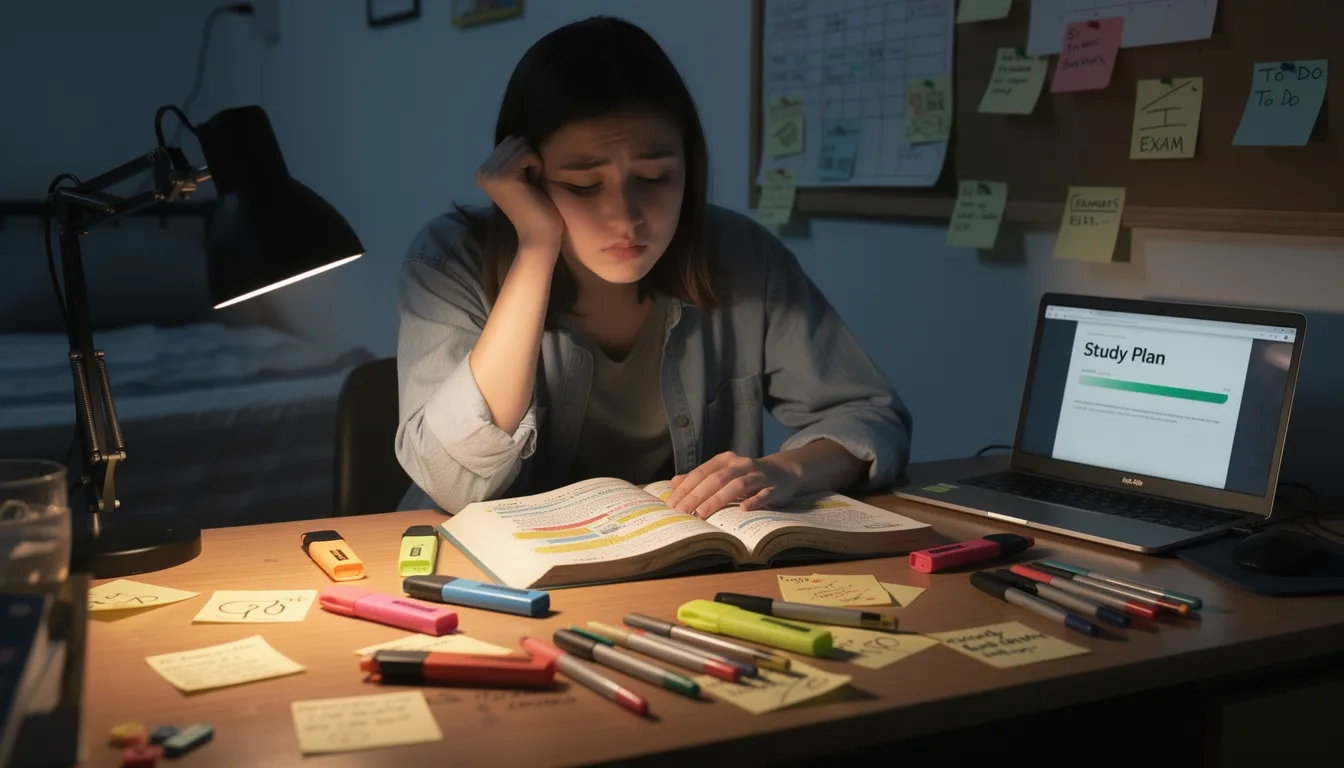
Most students read textbooks the same way they read a thriller — start at page one, keep going until it makes sense or time runs out. This is a terrible strategy. Not because the effort is wrong, but because the method treats a reference manual like a novel, and the brain stores information nothing like a hard drive loading files.
The research on this is pretty stark. Re-reading and highlighting, the two most popular study strategies among college students, are also among the least effective. We've known this for over a decade. Students keep doing them anyway because they feel productive. They are not.
Here's what actually works, and why.
Why Your Default Reading Strategy Is Lying to You
Re-reading creates an illusion, not learning. After going through a chapter twice, the text feels familiar. Paragraphs that confused you on the first pass seem clearer. That familiarity mimics comprehension. It isn't.
Cognitive scientists call this the "fluency illusion" — the brain's tendency to mistake recognition for recall. Katherine Rawson, a psychology professor at Kent State University, has studied this effect in depth. Her research shows students routinely overestimate how well they know material after passive re-reading, because the text feels familiar rather than because they can actually retrieve the information without it in front of them.
Highlighting has a nearly identical problem. A 2013 analysis published in Psychological Science in the Public Interest reviewed decades of studies and found that highlighting, as most students practice it, produces no meaningful benefit over simply reading. The core issue: novice learners don't know what's important yet, so they mark everything — which means they've marked nothing. As Rawson notes, students just aren't skilled at identifying critical information while they're in the middle of encountering it for the first time.
Every hour spent re-reading or color-coding is an hour not spent on strategies that actually move the needle.
Read Before You Read: The Survey Phase
Before you touch paragraph one, spend 8-12 minutes doing something counterintuitive: read everything except the actual text.
Skim all headings and subheadings. Read the chapter summary. Look at every figure, diagram, and caption. Read the end-of-chapter questions. If there's a key terms section, scan it.
This pre-reading builds a mental scaffold that makes the actual reading dramatically more efficient. Your brain is not a blank slate loading new data — it's an associative network that stores information by connecting it to things it already knows. When you survey first, you give incoming information something to attach to.
Think of it like reading a map before hiking a trail. You don't know every turn yet, but you know roughly where you're headed, what landmarks matter, and what the terrain looks like. That orientation changes the whole experience.
A quick self-test: after surveying a chapter, can you describe in three sentences what it's about, what the main sections cover, and what two or three key terms are? If yes, you've built enough scaffold to read productively. If not, spend another few minutes with the headings.
The SQ3R Method: Old for Good Reason
Francis P. Robinson developed SQ3R in 1941. That's not a selling point — it's evidence. This method has had 85 years of opportunities to be replaced, and nothing has managed it. Harvard's Academic Resource Center and Stanford's Center for Teaching and Learning both recommend it for textbook reading.
Research consistently shows students using structured methods like SQ3R retain 40-60% more material compared to unstructured reading.
The five steps:
- Survey — Scan headings, figures, and the chapter summary before reading
- Question — Turn each heading into a question ("The Krebs Cycle" → "What is the Krebs Cycle, and why does it matter?")
- Read — Read to answer your questions, not to absorb everything
- Recite — Close the book and answer your questions from memory
- Review — Revisit questions and answers during later study sessions
The Recite step is where most of the actual learning happens. Closing the book and retrieving answers is a form of active recall, and that's the most evidence-backed technique in educational psychology.
Mark McDaniel, Daniel Howard, and Gilles Einstein tested a simplified version of this framework in a study published in Psychological Science, comparing students who read-recite-reviewed against those who just read. Same total time. The recite group outperformed on retention tests — sometimes by a wide margin.
Active Recall: Where Learning Actually Happens
Learning doesn't happen during reading. It happens when you retrieve information.
Every time you pull a memory out of storage — even imperfectly, even with effort — you strengthen the neural pathway that holds it. This is called the "testing effect" or "retrieval practice effect," and it's one of the most replicated findings in all of cognitive psychology.
A 2024 study tracking 500 college students over a full semester found that students using active recall scored an average of 23% higher on final exams compared to those who relied on re-reading. The gap widened for complex material, where deep understanding matters more than raw memorization.
Practically, here's how to build active recall into your reading sessions:
- After each section (not the full chapter — each section), close the book and write down everything you remember
- Answer end-of-chapter questions without looking at the text first — check afterward
- Create flashcards from key terms before you feel "ready" to; the act of writing the question is already retrieval practice
- Explain the concept aloud in plain language, as if teaching someone who just walked in
That last technique, popularized by physicist Richard Feynman, is particularly good at exposing gaps. You can read a paragraph about the central dogma of molecular biology and feel like you get it. Try explaining it out loud without notes. You'll find out exactly where your understanding breaks down, which is far more useful than discovering it on an exam.
Spaced Repetition: The Part Most Students Skip
Reading a chapter well is step one. Retaining it three weeks later is step two, and most students never get there.
Hermann Ebbinghaus mapped this in the 1880s with his forgetting curve: without review, you forget roughly 70% of new information within 24 hours. By day seven, most of the rest is gone too.
Spaced repetition fights this by scheduling review right before forgetting occurs. Intervals start small — review after 1 day, then 3 days — and grow longer as material becomes stable in memory: 1 week, 2 weeks, 1 month. A 2025 study published in ScienceDirect found that pharmacy students combining active recall with spaced repetition significantly outperformed peers using passive review, with benefits visible on both short-term quizzes and longer retention tests weeks later.
| Review Strategy | Retention After 1 Week | Time Cost |
|---|---|---|
| Re-reading | ~30% | High |
| Highlighting + re-reading | ~35% | High |
| Active recall only | ~65% | Medium |
| Active recall + spaced repetition | ~80%+ | Lower once scheduled |
The app Anki (free and open-source) implements spaced repetition algorithmically — it surfaces cards right when you're about to forget them. But you don't need software. A physical index card box with dividers labeled "tomorrow," "3 days," and "next week" costs about $4 and works the same way.
Not All Chapters Deserve Equal Effort
Here's the thing no study guide wants to say directly: you probably shouldn't read every chapter with the same depth.
Do a 10-minute alignment check before opening the book. What percentage of the exam pulls from textbook readings vs. lectures? Which chapters have assignments attached? Has the professor explicitly mentioned any chapters as supplementary?
Some chapters deserve full SQ3R treatment with spaced review sessions. Others deserve a 20-minute skim for anything that contradicts your lecture notes. A few might deserve nothing beyond noting that they exist.
A quick decision framework:
- Core chapter + on the exam + professor covers it in lecture → Full SQ3R plus active recall plus spaced repetition
- Core chapter + on the exam + professor skips it → Full SQ3R plus active recall (the professor skipping it is a signal the textbook is your primary source)
- Supplementary chapter, mentioned once → Survey plus key terms scan
- Optional or additional reading → Read only if you're genuinely curious
Treating a 40-page supplementary chapter with the same rigor as a 40-page core chapter isn't diligence — it's poor allocation. And running out of time on material that actually matters is one of the most common, most avoidable academic mistakes there is.
Notes That Do Real Work
Most students take textbook notes by copying sentences. That's transcription, not learning.
The goal of notes is compression and connection — not documentation. If your notes could have been auto-generated by bolding the terms the textbook already bolded, they aren't doing much work for you.
Two approaches that consistently outperform standard note-taking:
Cornell Notes divide the page into a narrow left column (questions and keywords) and a wide right column (your notes). After reading a section, write notes on the right. Then — and this is the step people skip — write questions in the left column that your right-column notes would answer. Cover the right side, try to answer the questions from memory, then check. You've built a self-quizzing system directly into your note pages.
Concept mapping means drawing the relationships between ideas rather than listing them. When you force yourself to draw arrows between "supply," "demand," "equilibrium price," and "elasticity," you're encoding connections, not just isolated facts. This matters most in subjects like biology, economics, history, and chemistry, where understanding how things interact is the actual point.
Both methods take longer than copying sentences. They also produce dramatically better retention — which means less total review time before an exam, not more.
Bottom Line
- Stop passive reading. Re-reading and highlighting feel productive and produce almost nothing. Replace them with active recall: close the book, retrieve, then check.
- Use the SQ3R structure. Survey first, turn headings into questions, read to answer them, recite with the book closed, then review later. Harvard and Stanford's learning centers recommend it because it works.
- Space your reviews. A single good reading session followed by nothing still produces the Ebbinghaus forgetting curve. Schedule review at 1 day, 3 days, 1 week — the material will stick, and your pre-exam cramming sessions will get shorter, not longer.
The single most important idea: learning happens during retrieval, not during reading. Reading loads the data. Active recall is the practice that makes it permanent.
Frequently Asked Questions
How long should it take to read a textbook chapter?
A 30-40 page chapter using SQ3R typically takes 60-90 minutes for a first pass, including the survey and recite phases. Students who rush through by skipping active recall often spend more total time before exams because retention is poor and they need to re-read everything. Doing it right once is faster than doing it passively twice.
Is it better to read the textbook before or after lecture?
Reading before lecture gives you context that makes the lecture land better — unfamiliar vocabulary doesn't slow you down, and you can focus on what you don't understand rather than just transcribing what the professor says. Reading after lecture also works, especially when the lecture introduces a conceptual framework that makes the textbook clearer. The worst option, by far, is skipping the reading entirely and hoping lecture covered everything.
Does reading on a screen versus paper make a difference?
Research suggests it can. A 2023 study published in the International Journal of Human-Computer Studies found differences in comprehension and recall between print and digital reading conditions, particularly for higher-ability readers processing complex text. Screens tend to encourage skimming behavior. If you're reading digitally, use a dedicated PDF app rather than a browser, turn off notifications, and consider printing dense chapters you need to understand deeply.
Is highlighting ever actually useful?
Yes — but only when paired with active processing. Highlighting on a first read, before you know what matters, produces almost nothing. Highlighting on a second pass, after you've engaged with the content, can help with review. The most effective version pairs any marking with an annotation: a question in the margin, a brief restatement in your own words, or a flag indicating "I don't actually understand this yet."
What's the biggest mistake students make with textbooks?
Reading every chapter with equal depth, linearly, from page one. Textbooks are reference materials, not novels. Skipping the survey phase, ignoring end-of-chapter questions, and spending equal time on supplementary readings and core chapters all compound into significant wasted hours. Prioritize before you open the book.
How do I stay focused when reading a dense chapter?
Work in 25-40 minute blocks rather than marathon sessions. Dense academic text depletes working memory faster than casual reading. Taking a 5-minute break between sections — and using that break to mentally review what you just read rather than opening your phone — actually improves comprehension on the next block. The mental review during the break is, itself, a retrieval practice session.
Sources
- Reading Textbooks Effectively – UNC Learning Center
- SQ3R – Harvard Academic Resource Center
- Reading Efficacy: The SQ3R Method – Stanford Center for Teaching and Learning
- Highlighting Is Ineffective – Edutopia
- Spaced Repetition and Active Recall Improves Academic Performance Among Pharmacy Students – ScienceDirect (2025)
- Textbook Reading Strategies for Ultra-Efficient Learning – College Info Geek