Professor Office Hours: How to Use Them (And Actually Benefit)
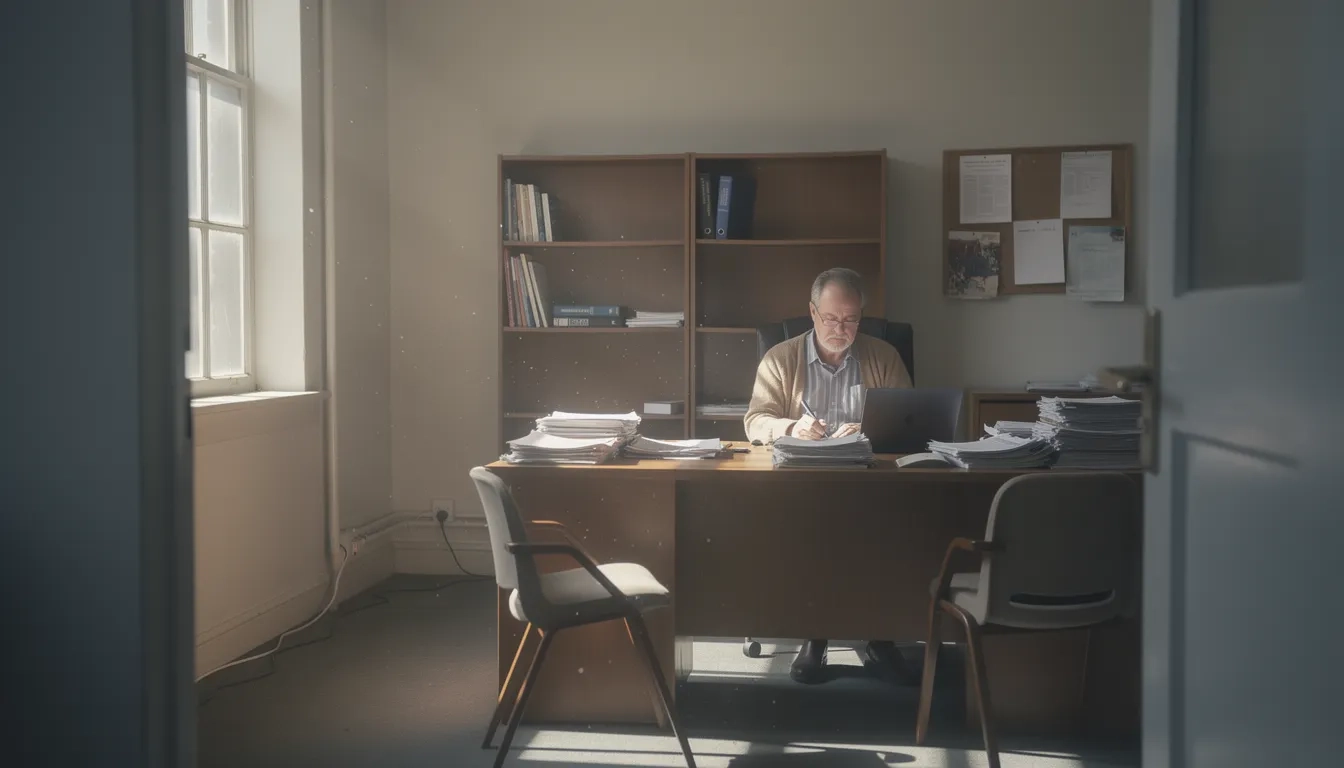
Most college students pay tens of thousands of dollars per year in tuition. Built into that price — rarely mentioned in any brochure — is something extraordinary: 3 to 5 hours per week of free, private access to a subject-matter expert who already knows exactly what will be on your exams.
Office hours. Seats almost always empty.
A 2013 study published in the Journal of Political Science Education tracked 406 students across eight courses over four years and reached a blunt conclusion: office-hour visits are positively correlated with academic performance. Not loosely associated with. Positively correlated with. And yet a Spring 2021 Chapman University survey found that most students never show up at all — and those who do tend to arrive the week before finals, by which point even the most generous professor can't do much.
The math doesn't add up. Here's how to fix it.
Why Almost Nobody Goes (The Data Is Embarrassing)
The Chapman University survey found that 40% of students blamed scheduling conflicts for skipping office hours. Only 16% of instructors believed scheduling was actually the problem. Over a quarter of faculty attributed low attendance to students simply not making the effort.
Both sides are probably partially right. But there's a more honest explanation buried in the data.
Most students believe office hours are for struggling students. They only show up when desperate — or avoid going entirely because they don't want to look desperate. This is the real barrier, not the calendar.
A first-generation college student who has never watched anyone model "going to talk to a professor" doesn't have a template for what that interaction looks like. It feels presumptuous. Like showing up uninvited to someone's house. That instinct is exactly backwards.
First-generation and underrepresented students attend at lower rates than their peers — and they stand to gain the most. Office hours are one of the few places on campus where a student can directly build social capital with a faculty member: the person who writes recommendation letters, fills research assistant slots, and knows which graduate programs or companies are actually worth pursuing. The Georgetown University analysis of office-hour attendance found that these students are missing a direct path to opportunities that their more privileged peers are quietly using.
What Office Hours Are Actually For
Here's the misconception worth killing early: office hours exist for students who don't understand the material.
Wrong. That's maybe 20% of why you should go.
The real menu:
- Getting feedback on a paper before you submit it (most professors genuinely prefer this)
- Understanding how the course connects to the professor's own research
- Asking about career paths in the field — who hires, what graduate programs matter, which certifications aren't worth the money
- Getting a sense of how the professor actually thinks, which makes your writing sharper
- Laying the groundwork for a recommendation letter months before you need one
- Finding out about research assistant positions that never get publicly posted
The Harvard College guide to office hours puts it plainly: students should not feel they are imposing. Professors set aside these hours specifically because they want those conversations. The quiet waiting room is not a sign of unwelcome — it's a sign that most students are scared for no good reason.
One genuinely useful move: ask about the professor's research and how it connects to what you're studying. When you understand why a particular paper was assigned — what debate it enters, what argument it supports — your essays stop summarizing and start engaging. That shift alone can move a B+ to an A.
How to Prepare Before You Walk In
The most common mistake: showing up empty-handed and saying "I'm just kind of confused about everything." That visit rarely goes well. The professor can't help with "everything." You leave with nothing useful, and neither of you enjoyed it.
Spend 15 minutes before each visit doing this instead:
- Review your notes from the last lecture and find one or two specific points where your understanding broke down
- Write down your questions before you arrive — the act of writing clarifies what you actually need
- Check whether the question can be answered by re-reading the textbook or syllabus. If yes, do that first.
- Frame each question as: "I understand [X], but I'm not clear on how that connects to [Y]."
That last framing matters. "I understand that GDP measures total economic output, but I'm not sure why it doesn't capture income inequality" is a real question the professor can work with. "I don't get macroeconomics" is not.
If you're visiting about a paper, bring a draft or at least an outline. Professors are far more useful when they can react to something concrete than when they're asked to think on your behalf from scratch.
What to Do When You Get There
Walk in. Sit down. Introduce yourself.
That sounds obvious. But many students arrive and hover awkwardly in the doorway waiting for permission to exist. Just go in.
The introduction is one sentence: "Hi, I'm [Name], I'm in your [Class Name] on Tuesday/Thursday." That's it. In large lecture courses, professors teach hundreds of people — they won't know your face yet. The introduction anchors you.
Then lead with your strongest question, not your smallest one. The instinct is to warm up with easy questions and build toward the hard one, but office hours have time limits (usually 15 to 30 minutes, sometimes shared with other students waiting). Lead with what matters.
Take notes during the conversation. It signals that you value their input, and it forces active engagement instead of nodding along while forgetting everything. Professors notice.
At the end, summarize what you took away. Something like: "So if I'm understanding correctly, the argument is that...?" This gives the professor a chance to catch any misunderstanding before you walk out the door and write a paper based on it.
"Students should not feel that they are imposing. Professors actively want students attending office hours — these conversations enhance both teaching and learning." — Harvard College Office Hours Guide
The Long Game: Recommendations and Research
Here is something nobody tells you as a freshman: a strong recommendation letter requires that the professor actually knows you. A form letter saying "this student received an A in my 300-person lecture" is nearly useless for graduate school, medical school, law school, or competitive jobs.
For a letter that says something real, the professor needs to know how you think, what you care about, and what you've contributed beyond showing up to class. Office hours are how that happens. Not in one visit — across several, spread over a semester.
Start early. Students who begin building that relationship in the first four weeks have the whole semester ahead of them. Students who email in April asking for a May deadline letter get a politely worded no. That's not a knock on the professor — you'd need time too if someone you barely knew asked you to vouch for them in writing.
Research assistant positions work exactly the same way. Many faculty hire undergrads to help with data collection, literature reviews, or lab work. These positions are often filled by word-of-mouth, not job boards. A student who visited twice, asked sharp questions about the professor's research, and showed real curiosity has a foot in the door that a student who only appeared on a grade spreadsheet does not.
What Not to Do
A few things that consistently go wrong:
Don't make the first visit a favor request. Asking for an extension, a grade bump, or special consideration on your very first visit turns the entire interaction transactional. Come with a question about course material first. Then, if you have a legitimate situation, bring it up.
Don't complain about the course. Criticizing the lecture format or arguing about a rubric positions you as adversarial. If you disagree with a grade, ask how to improve rather than contesting the outcome. "What would have made this answer stronger?" is productive. "I think I deserved more points" lands badly every time.
Don't show up having skipped class. Asking a professor to re-teach a lecture you missed is a rough look. They know.
Here's a quick reference:
| Do This | Not This |
|---|---|
| Come with specific, written questions | "I'm just generally confused" |
| Introduce yourself and name your course | Assume they know who you are |
| Ask about the professor's research | Only visit the week before finals |
| Take notes during the meeting | Nod along, forget everything |
| Visit early and revisit regularly | First visit in week 14 |
| Ask "how can I improve this?" | "I think my grade is wrong" |
Timing: When to Go and How Often
The best first visit is during week two or three of the semester. The professor isn't yet swamped, the semester is fresh, and your visit stands out simply because nobody else is there yet.
After that, every two to three weeks is a reasonable rhythm for a course you're actively engaged in. You don't need to manufacture reasons — "I read ahead and had a question" or "I want feedback on my paper direction before I write it" are both legitimate even when nothing is on fire.
For courses where you want a recommendation letter or a research opportunity, aim for 4 to 5 visits across the semester. That's enough to be genuinely memorable without being overbearing.
Don't wait until something breaks. The students who get the most out of office hours treat them like a scheduled part of the course — a recurring calendar item, not an emergency service they call in crisis.
Bottom Line
Office hours are the most underused resource on any college campus. The return on a single 20-minute visit — better understanding, a stronger paper, the beginning of a relationship that could produce a recommendation letter — is absurd relative to the effort.
- Go early in the semester, before you're desperate and before every other student shows up
- Come prepared with a specific question framed as "I understand X, but not Y"
- Introduce yourself every time until the professor knows your name
- Use the long game — recommendation letters and research positions go to students who showed up consistently, not just once in a panic
- Treat office hours like a scheduled part of the course, not a confession booth you enter only when failing
Show up. Ask a real question. Take notes. Do that four or five times across a semester, and you'll have a relationship that most of your classmates simply don't.
Frequently Asked Questions
What should I talk about at office hours if I understand the material fine?
You don't need to be struggling to have a productive visit. Ask about the professor's own research, how the course connects to real-world applications, which topics are worth exploring further if you're interested in the field, or get early feedback on a paper topic you're considering. Students who go when things are going well almost always get more out of the visit than those who only show up in crisis mode.
Is it rude to just drop in, or should I email ahead?
If office hours are listed as drop-in, you can walk in during the scheduled time without notice — that's what they're for. If the professor uses appointment slots, book one. When in doubt, a brief email the day before ("I'm planning to come by Tuesday to ask about [topic]") is never wrong and occasionally appreciated in a busy week.
Will my professor think I'm weak for asking basic questions?
No. Professors lose patience with students who show up without thinking, not with students who have genuine gaps. A basic question asked sincerely, after you've done the reading, is not embarrassing. Sitting silent in class for 14 weeks and then disputing your final grade is a much worse look.
Is there such a thing as going too often?
In practice, almost no student goes too often — the problem runs in the other direction. If you're visiting every week with substantive questions or paper feedback, that's completely normal. The only awkward version is showing up with nothing to say because you felt obligated. Come with purpose, and frequency is rarely an issue.
Can office hours actually move the needle on grades?
The research says yes. Guerrero and Rod's 2013 study in the Journal of Political Science Education found a direct positive correlation between office-hour visits and academic performance across 406 students over four years. The mechanism is straightforward: you catch misunderstandings before they show up on exams, you get direct feedback on your thinking, and you stay more engaged with the material overall.
What if my professor seems unapproachable in class?
Go anyway. A professor who appears intimidating in a 200-person lecture is often completely different one-on-one. The classroom involves performance, authority, and time pressure. Office hours are conversational. Most students who push through the initial awkwardness find it far less frightening than they expected — and often leave surprised by how much they got out of it.
Sources
- A Guide to Office Hours – Harvard College
- Why Are So Few Students Attending Professors' Office Hours? – Georgetown The Feed
- How to Make the Most of Office Hours – Penn Weingarten Center
- Professor Office Hours: Dos and Don'ts – Fastweb
- Engaging in Office Hours: Student-Faculty Interaction and Academic Performance – Journal of Political Science Education via ERIC