How to Win a National Writing Competition (What the Winners Know)
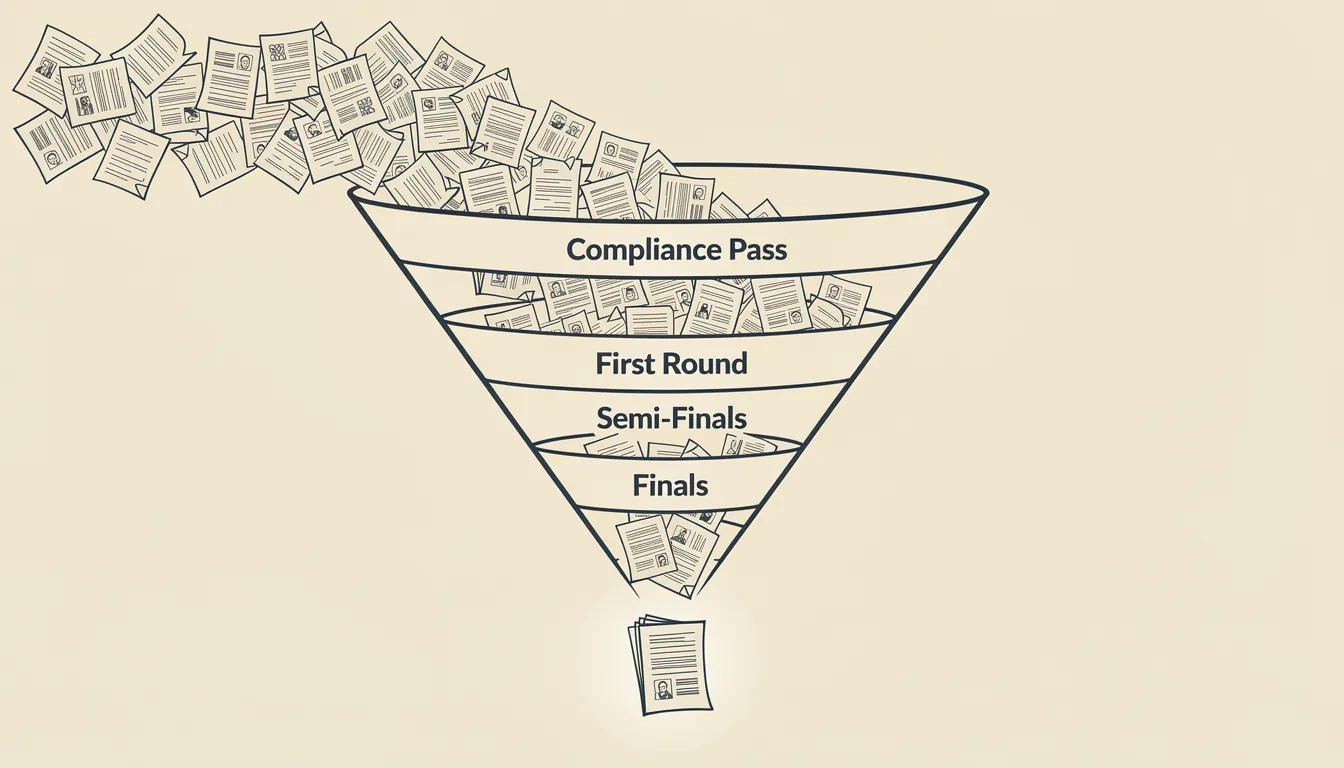
In a 2023 writing competition post-mortem, organizers found that 72.41% of all disqualified entries were eliminated for one specific reason: the author's name appeared somewhere in the document. Not in the story itself — in a filename, a header, a footer. Before a judge read a single sentence.
That's the real shape of national writing competitions. They're not purely talent showcases. They're elimination funnels. And most writers lose before the creative judging even starts.
The Funnel Most Entrants Never See
Every national competition operates in rounds. The first round is almost never about craft — it's a compliance pass where screeners (often volunteers, sometimes junior staff) eliminate entries that broke the rules in some way.
The name-in-document problem accounts for nearly three-quarters of disqualifications in blind competitions. Exceeding word count limits accounts for most of the rest. Together, these two errors eliminate a huge portion of the field before any judge considers a narrative choice.
The Scholastic Art & Writing Awards — one of the largest and most competitive youth writing programs in the country — received more than 335,000 entries in 2026. Roughly 2,500 earned national medals. That's around 0.75% of the total pool. But the writers who didn't place weren't all out-written. Many were simply out-prepared.
Writer's Digest competition advisors have documented that more than half of all submissions fail to get judges "to commit beyond the first paragraph." The implication is stark: you can lose a national competition without anyone ever reading the part you worked hardest on.
What First-Round Screeners Are Actually Doing
First-round readers aren't hoping your entry is good. They're working through a rubric that tells them when to eliminate.
Formatting compliance is evaluated before originality. A wrong font, single spacing where double-spacing was required, or a decorative drop cap at the start of your story can end your entry immediately. Screeners treat formatting deviations as a signal that you didn't read the guidelines — and if you didn't read the guidelines, they don't need to read you.
Here's what first-round screeners typically scan in under two minutes:
- Is the submission anonymous (if required)?
- Does it conform to font, spacing, and margin specs?
- Does it fall within the word or line count limit?
- Does it include any required forms or cover sheets?
- Does the opening merit continued reading?
Pass all five and your work finally reaches a reader who cares about story. Most entries never get there.
What Judges Look For Once the Real Reading Begins
After the compliance cuts, the creative judging is structured around four primary dimensions. Page Turner Awards judges evaluate clarity and cohesion (does the narrative flow with purpose?), originality (does the piece surprise?), character depth (are these people real?), and thematic integration (is the prompt engaged organically, not slapped on?).
But the single factor that separates finalists from winners is almost never written in the judging rubric: emotional resonance.
"Craft and execution matter most — but either a piece moves you or it doesn't. That gut reaction is what separates the finalist from the winner."
This creates an interesting tension. You have to be technically clean enough to survive early rounds, then technically invisible by the finals — meaning craft so smooth it never interrupts the emotional experience.
The non-obvious point: judges in later rounds are typically more experienced readers than early screeners. They've read thousands of competent stories. Competence bores them. What they're hunting for is surprise — the sentence that works differently than expected, the ending that recontextualizes everything before it.
Judges have also been consistent on one pattern: entries that front-load quality and fade in the second half lose. Winners maintain high standards all the way through. There's nowhere to hide once you're being seriously considered.
Your Opening: Where the Competition Is Actually Decided
Contest judges say the same thing across different competitions and genres: most entries start too late or too early.
Starting too early means opening with weather, setting descriptions, or backstory before any tension exists. Starting too late is less common but equally fatal — burying the inciting incident under paragraphs of context the reader has no reason to care about yet.
The correct entry point is almost always closer to the action than feels comfortable. If your story follows a woman confronting an estranged parent, don't open with her childhood. Don't open at the airport. Open in the hallway outside the room.
Short opening paragraphs signal confidence. A dense block of text at the top of page one telegraphs effort, not control. Visual breathing room on an opening page reads — even subliminally — as a writer who knows what they're doing.
And resist the urge to grab attention with shock. A profanity in the first sentence, a visceral image dropped without context — experienced judges read these as gimmicks. What actually creates a hook is a specific detail that generates a question the reader needs answered. Not shock. Curiosity.
Choosing the Right Competition Before You Write a Word
Not every national competition is looking for the same thing. Submitting experimental fragmented flash fiction to a competition that historically rewards commercial realism is working against yourself from the start.
Before you enter anywhere, research these factors:
| Factor | What to Research | Warning Sign |
|---|---|---|
| Past winners | Read 3–5 winning entries | They sound nothing like your voice |
| Judge panel | What do they publish or edit? | No genre-relevant experience |
| Rights clauses | Do they want rights to your work? | "All rights" for unpaid recognition |
| Entry fee vs. prize | Is the payout commensurate? | $50 fee for a certificate |
| Category match | Is your genre/length represented? | Forcing your work into a wrong slot |
The Scholastic Art & Writing Awards offer 28 distinct categories — personal essay, humor writing, science fiction and fantasy, and more. Entering a personal essay into a science fiction category doesn't just hurt your odds; it may disqualify you outright.
My honest position: writers who enter national competitions without reading past winners are wasting their entry fees. Every judging panel has a sensibility, and that sensibility is visible in the archive. Study it before you submit anything.
The Revision Pass That Actually Changes Results
Most writers revise for correctness. Winning writers revise for impact. Those are different activities.
Read your entire piece aloud — not in your head, out loud. Your mouth stumbles where your eye slides past problems. Awkward rhythms, repeated words, dialogue no one would actually speak: all of it surfaces when you have to physically produce the sounds.
Then interrogate every adverb. Judges from multiple major competitions consistently flag adverb-heavy prose as a marker of a developing rather than developed writer. "She walked quickly" versus "she rushed" — both communicate speed, but the second trusts the verb. Replace adverb-plus-weak-verb with a single stronger verb every single time.
Finally, try cutting your last paragraph entirely. Endings drafted in the heat of writing often over-explain the emotional point the story already made. Read your piece without the final paragraph. If it's stronger — and it often is — delete it.
Get honest outside readers. Not friends. A writing group, a workshop, a reader with no investment in your feelings. The feedback that stings is usually the feedback that's accurate.
The Habit That Separates Consistent Placers From Everyone Else
Writers who regularly place in national competitions enter many of them — and they treat losses as data, not verdicts.
When competitions offer judge feedback (the Page Turner Awards and several regional programs do), requesting it after a loss is one of the fastest improvement mechanisms available. A single judge's note explaining why your ending didn't land teaches you something that 10 craft books cannot.
Accept that subjectivity is real. A story that wins one competition may place nowhere in another. Judges have tastes; panels disagree. The goal isn't to write the objectively "perfect" story — it's to write something that genuinely connects, and then send it to enough readers that some of them happen to be judges.
Stack the deck in your favor: follow the rules perfectly, open with intention, revise until you can't find anything left to fix. Then send it out. Then send it somewhere else.
Bottom Line
- Read the rules twice, then once more. The majority of disqualifications are preventable technical errors — not quality issues. Submit anonymously, in the specified format, within the word count.
- Study the archive first. Past winners reveal a competition's sensibility far better than any written rubric. If you haven't read five winning entries, you're not ready to submit.
- Revise for impact, not just correctness. Read aloud, cut adverbs, try deleting your last paragraph, get honest feedback before you hit submit.
- Enter more competitions. Consistent placers submit often and learn from judge feedback when it's available. Volume and targeted research compound over time.
- Technical execution gets you through round one. Emotional truth wins the whole thing. Keep both in mind from the first draft.
Frequently Asked Questions
Does submitting early in the deadline window improve my chances?
Not for scoring — blind judging means your submission date is invisible to judges. But early submission protects you from practical disasters: portal crashes, upload errors, and last-minute formatting panics are all common in the final 24 hours before a deadline. Aim for one week out.
Can I submit the same piece to multiple competitions at the same time?
It depends on the competition. Many short fiction and poetry contests allow simultaneous submissions — it's standard in the literary world. But some competitions, especially those with significant prize money, explicitly prohibit it. Read the fine print carefully. If you win one while simultaneously submitted elsewhere, withdraw from the others immediately.
Myth vs. Reality: Does originality matter more than technical skill?
Both matter, but at different stages. In early rounds, technical compliance and opening quality are what keep you alive. In final rounds, originality is what wins. The mistake is optimizing for only one. A technically perfect but generic story rarely wins anything. A wildly original but sloppily executed one rarely survives round one. You need both, sequenced properly.
How strictly do judges enforce the theme or prompt?
More strictly than most entrants expect. The JFK Library's Profile in Courage Essay Contest, for example, explicitly scores for how directly an entry engages their stated theme. A beautifully written piece that only tangentially addresses the prompt will frequently lose to a lesser-written piece that engages the theme with precision. "Organically integrated" is the standard — not bolted on at the end, but woven through the whole piece.
Should I enter competitions that charge entry fees?
Entry fees fund prizes, judging costs, and administration. Fee-based competitions from established organizations — Writer's Digest, Page Turner Awards, most university-sponsored programs — are generally worth the investment. A $20–$30 fee for a competition with a $1,000+ prize is typical and reasonable. Be skeptical of high fees paired with vague prizes or organizations you can't verify through past winners or reputable literary directories.
How do I know if a competition is legitimate?
Check whether past winners are named and findable. Look for a physical address or affiliated institution. Legitimate competitions publish their judges' names and credentials. Verify the organization through the Council of Literary Magazines and Presses (CLMP) or Poets & Writers database — both maintain directories of vetted competitions. If a competition can't pass a five-minute Google search, move on.
Sources
- Deciphering the Judging Criteria: A Guide to Short Story Writing Competitions — Page Turner Awards
- Making It Past the First Round: Writing Competition Tips — Writer's Digest
- How to Judge Writing Competitions for Children, Adults, Beginners and Seasoned Authors — Nail Your Novel
- The Scholastic Art & Writing Awards Announce 2026 Class of National Teen Medalists — Scholastic
- 5 Biggest Writing Mistakes and How to Fix Them Before Entering a Writing Contest — Page Turner Awards
- Common Entry Mistakes to Avoid — TrendnDailyAmerica