How to Read and Interpret Your MCAT Score Report
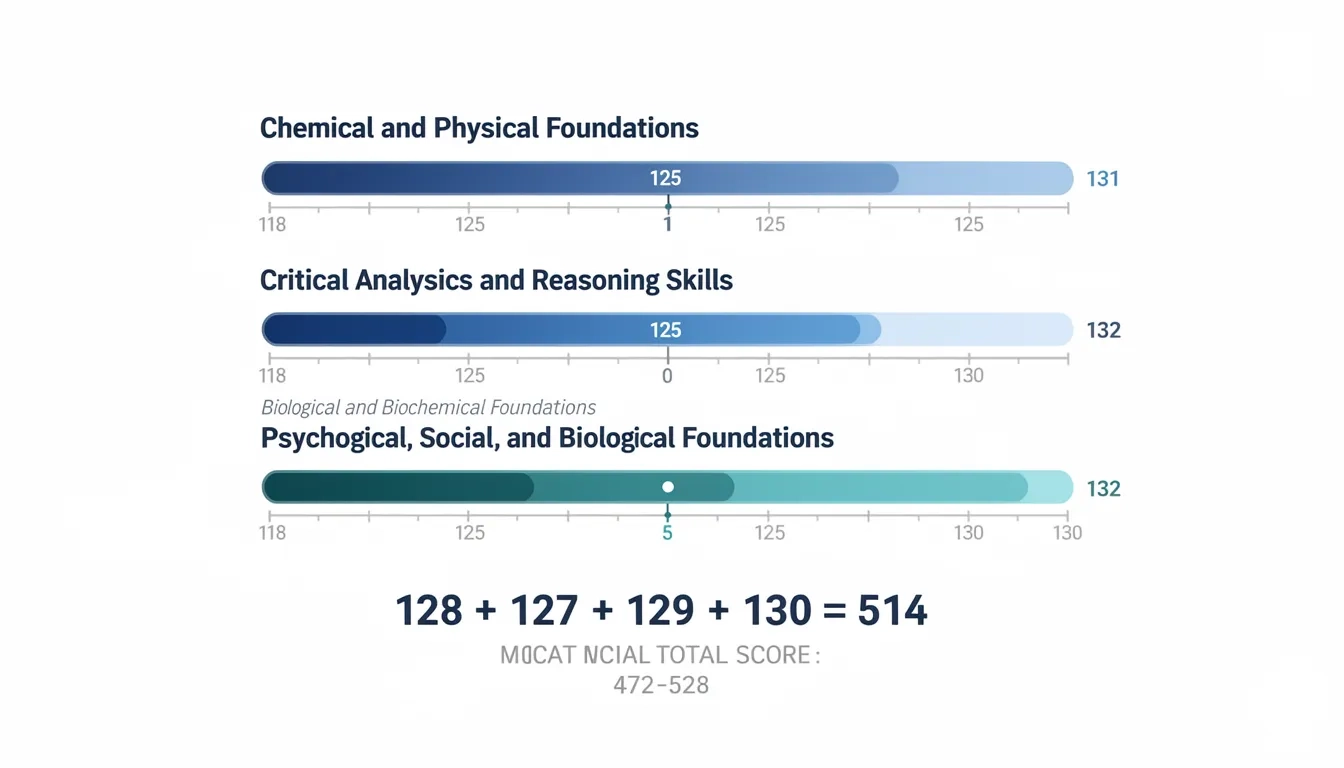
Your MCAT results drop into your AAMC account roughly 30 to 35 days after test day, and when they do, the page can feel like a spreadsheet that forgot to include a legend. A scaled score for each of four sections. A total. A percentile next to each number. A confidence band that nobody mentioned in your prep course. Most students stare at it for a few seconds, then either celebrate or panic — without fully understanding what they're actually reading. This guide fixes that.
The Score Structure: Four Sections, One Total
The MCAT has four independently scored sections. Each runs from 118 to 132, with 125 as the midpoint. Those four scores add up to your total, which spans 472 to 528, with 500 as the midpoint.
| Section | Abbreviation | Core Content |
|---|---|---|
| Chemical and Physical Foundations of Biological Systems | Chem/Phys | Chemistry, physics, biochemistry |
| Critical Analysis and Reasoning Skills | CARS | Reading comprehension, reasoning |
| Biological and Biochemical Foundations of Living Systems | Bio/Biochem | Cell biology, genetics, physiology |
| Psychological, Social, and Biological Foundations of Behavior | Psych/Soc | Behavioral sciences, health disparities |
The midpoints serve as a reference, not a target. AAMC designed the scale so that 500 represents median performance among test takers (not a passing or failing mark). Many students walk in expecting a 100-point scale and feel disoriented by 472–528. It's just the range.
Section order on your report matches the order you tested them on exam day. The scores appear alongside percentile ranks for each section separately, then again for your total.
Raw Scores vs. Scaled Scores: Why You Never See Raw Numbers
The AAMC never releases your raw score. Your report shows only scaled scores, and that's a deliberate design choice.
Every MCAT administration draws from a pool of questions. Some versions are slightly harder than others. Without adjustment, a student who happened to get a tougher version would be penalized compared to someone who got an easier one. AAMC solves this through a process called "equating" — a statistical adjustment that compensates for those small difficulty differences across test dates.
The result: a 127 in CARS means the same thing whether you tested in January or September. The actual conversion formula is not published.
This also means you can't reverse-engineer how many questions you got right. The AAMC does not release any question-level diagnostic breakdown with your official score report. One more thing worth knowing: there's no penalty for wrong answers. Your raw score is simply the count of correct responses before equating is applied.
What the Percentile Rank Tells You (and What It Doesn't)
Next to each scaled score on your report, you'll see a percentile rank. That number represents the percentage of test takers who scored the same as or lower than you.
Score a 515? You're around the 91st percentile. A 510 sits near the 79th. A 500 — the scale midpoint — puts you at about the 56th.
The reference pool has a May 1st birthday. Every year, AAMC updates the percentile tables using three years of combined test data. The figures currently in effect (May 2025 through April 2026) draw from 293,882 exams administered between 2022 and 2024. The average total across that pool was 500.5, with a standard deviation of 11.2. Those are the benchmarks your score is measured against.
That rolling three-year window smooths out year-to-year noise. But it means your percentile can shift slightly over time even without your score changing, because the reference cohort itself changed.
The people in that reference pool are every pre-med who sat for the MCAT across three testing years — one of the most academically self-selected groups you can construct. The 50th percentile among MCAT test takers is nowhere near the 50th percentile of U.S. college students generally.
A 60th percentile MCAT score doesn't mean you're average. It means you're above average within a highly motivated, science-focused group. That context shapes how you should read your own result, and how you should talk about it in interviews.
The Confidence Band: The Part Nobody Talks About
Your score report includes a confidence band — a range around each score reflecting statistical measurement uncertainty. Section bands span ±1 point. The total score band spans ±2 points.
A reported total of 510 comes with a band of 508–512. That range represents where your "true" score (what you'd average across many retakes under identical conditions) most likely falls. No test measurement is perfectly precise, and the AAMC is transparent about this in a way most test-takers skim past.
This matters most when you're thinking about a retake. Splitting hairs over small score differences is often a mistake. If you scored a 510 and retook the exam and scored a 512, the confidence bands for both results overlap almost entirely. An admissions officer who understands psychometrics sees those results as statistically equivalent.
The practical rule: a retake needs to produce at least a 4-point improvement to signal genuine growth rather than variation within the measurement error range. Below that threshold, the change looks like noise, not progress. If you can't realistically expect that kind of jump with your prep capacity, a retake may cost more than it gains.
Section Scores: Reading the Profile, Not Just the Total
Admissions committees look at your full section profile. They see it. Imbalanced scores draw more scrutiny than most applicants expect.
Lopsided scores raise questions, even at strong totals. A 522 built on 130 / 130 / 124 / 138 looks structurally different from 131 / 130 / 130 / 131. The student with a 124 in one section will likely face questions about that dip, especially in an interview.
Some non-obvious details about section distributions in the current dataset:
- Psych/Soc has the highest section average among all test takers at 125.9, making the competitive range at the top of that section the most compressed of the four.
- CARS and Chem/Phys average around 124.6 each, so a 128 in CARS is statistically rarer than a 128 in Psych/Soc.
- Many programs enforce per-section minimums (commonly 124 or 125) regardless of total score. A 513 with a 123 in CARS can trigger an automatic screen at programs with section floors, even though the total looks fine.
Use this three-step framework when analyzing your section profile:
- Is any section below 124? That's the threshold most programs treat seriously.
- Does your weak section align with your stated specialty? A future psychiatrist with a low Psych/Soc score carries a harder burden to explain than a future radiologist with the same score.
- Does the pattern conflict with your academic record? A biochemistry major with a low Bio/Biochem score invites harder questions than a humanities major in the same position.
A modest weak section isn't automatically disqualifying if GPA, research, or clinical experience provides context. But go in knowing how your profile reads.
Score Benchmarks: What Different Totals Mean for Admissions
The average MCAT for medical school matriculants — students who actually enrolled, not just applied — was 511.9 in the most recent AAMC data, alongside an average GPA of 3.77. That 511.9 is the real target for most MD programs, not the 500.5 average of all test takers.
| Total Score | Approx. Percentile | Admissions Context |
|---|---|---|
| 524–528 | 99th–100th | Elite programs, top-10 schools |
| 519–523 | 96th–99th | Competitive for top-20 MD programs |
| 515–518 | 90th–95th | Strong for most MD programs |
| 510–514 | 79th–90th | Competitive for many MD programs |
| 504–509 | 60th–78th | Solid for DO programs, some MD |
| Below 504 | Below 60th | Consider retake or post-bacc work |
These are guidelines. A 508 with a 3.95 GPA and clinical research publications lands differently than a 508 with a 3.2 GPA and minimal extracurriculars. The MCAT doesn't exist in a vacuum.
Multiple Attempts: What Schools Actually See
If you've taken the MCAT more than once, every scored attempt from the past three testing years appears automatically when you send scores to a program. There's no selective reporting option.
The only way to prevent a score from being recorded is to void the exam before leaving the testing center that day. A voided attempt shows as "V" on your record — no score visible — but it still counts toward your testing limits (four lifetime attempts, three in any single calendar year).
What do schools do with multiple scores? Policies vary:
- Most programs look primarily at your highest total.
- Some average all attempts.
- A small number review the full arc holistically, particularly when the trajectory is notable.
A significant improvement (say, 499 to 516) almost never raises red flags. It raises eyebrows in the good way — it shows persistence and real preparation. What draws actual concern is a declining pattern or a score that dropped sharply on a retake, which can prompt questions about test anxiety or preparation approach.
The Numbers Admissions Officers Actually Focus On
Here's what gets missed when students fixate on a specific target number: admissions offices use the MCAT primarily as a threshold filter, not as the main differentiator above that threshold.
Below a school's implicit cutoff, a low score closes doors. Above it, the MCAT becomes one data point among many. At that point, the personal statement, recommendation letters, research experience, clinical hours, and interview performance carry growing weight relative to a 3-point score difference.
My honest read: if your score clears 510 with balanced sections, you've largely done your job on the MCAT. The gap between a 512 and a 516 matters far less than most applicants imagine when stacked against strong research, authentic clinical exposure, or a personal statement that makes a reader pause.
A retake carries real costs. The exam runs $345 per attempt as of 2025. Preparation takes months. Scores can go down. Before committing, weigh whether those months would produce a bigger admissions return through MCAT prep or through strengthening other parts of your application.
Bottom Line
- Check your section profile before your total. Any section below 124 deserves a plan — retake strategy or a clear application narrative around it.
- Understand the confidence band. A retake needs to move beyond the ±2-point margin of statistical noise. Target at least 4 points of improvement before scheduling another attempt.
- Know your target schools' per-section minimums before deciding anything. Some programs have section floors that a strong total score cannot override.
- Put your percentile in context. The reference pool is one of the most academically selected groups in the country. A 60th percentile here is not an average performance.
- If your total clears 510 with balanced sections, redirect your energy toward the rest of your application. The MCAT has done its job.
Frequently Asked Questions
What does the confidence band on my MCAT score report mean?
The confidence band is a range showing the statistical uncertainty in your score measurement. Section bands cover ±1 point; the total score band covers ±2 points. A 510 total with a band of 508–512 means your measured score carries that degree of inherent variability — think of it as the margin of error for the exam itself, not for your preparation.
Do medical schools see all of my MCAT attempts?
Yes. Every scored attempt from the past three testing years is automatically sent when you release scores to a program. A voided exam shows as "V" with no score recorded, but it still counts toward your testing limit. Attempts older than three years are not reported to schools.
My percentile looks lower than expected — did my score change?
No. Scaled scores don't change after release. But AAMC updates percentile tables every May 1st using a rolling three-year reference pool. If the newest tables incorporated a stronger-performing cohort, your percentile rank can drop even though your score is identical. This happens most noticeably to students who tested before a May 1st update and then check the new tables.
Is a low CARS score more damaging than a low score in another section?
For most MD programs, yes. CARS performance correlates with clinical reasoning and reading-intensive coursework, and several top programs treat a sub-125 CARS score as a soft disqualifier — even when the total score is competitive. CARS is also the section least responsive to content review; meaningful improvement typically requires months of deliberate reading practice, not a content cram.
How do I decide whether to retake the MCAT?
Look at three things: whether your total clears your target schools' average matriculant score, whether any section falls below 124, and whether you can realistically improve by 4+ points given your available prep time. A retake that produces 1–2 points offers no statistical advantage over your current score and adds delay, cost, and risk to your application cycle.
Does my score report show how many questions I answered correctly?
No. The AAMC reports only scaled scores and percentile ranks — no raw score, no question-level breakdown, no diagnostic by topic. This is intentional: raw scores aren't directly comparable across test dates without equating, so the AAMC publishes only the equated result.