MCAT Behavioral Science: Master Every Psychology Topic
Most pre-med students save the Psych/Soc section for last. It feels approachable — you've taken intro psych, sociology seems like common sense, and compared to biochemistry mechanisms, it looks like the kind of material you can knock out in two weeks. That instinct costs people their target score more often than any other miscalculation on this exam.
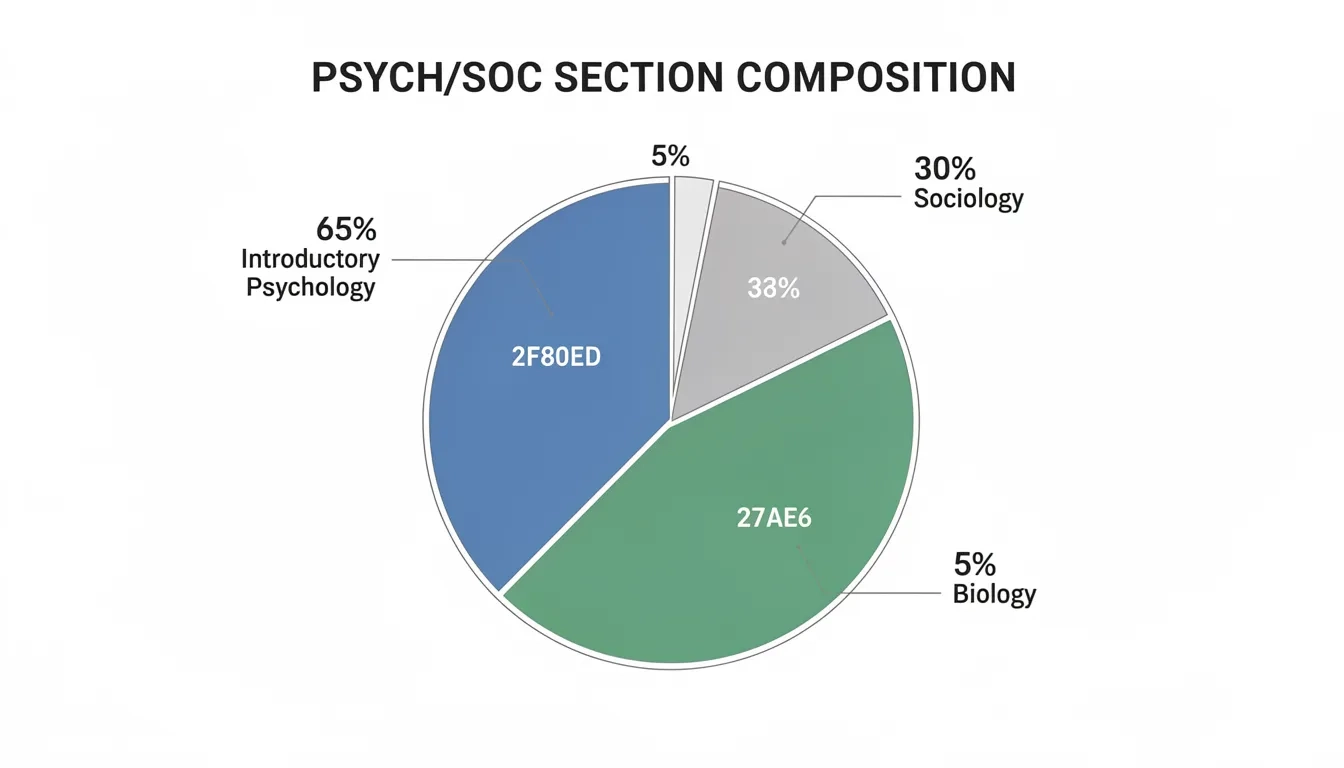
The section has exactly 59 questions in 95 minutes (about 97 seconds per question), and 65% of those questions draw from psychology material that rewards precision far more than familiarity. Here's what that actually means for how you should study.
What the Psych/Soc Section Actually Measures
The discipline breakdown is lopsided in psychology's favor. According to the AAMC's official content outline, introductory psychology accounts for ~38 of the 59 questions. Introductory sociology covers ~18. Introductory biology gets 3. If you're dividing study time equally across all three, you're trading psychology points for biology content that barely moves the needle.
But the discipline split is only half the story. Skills distribution matters just as much as topic coverage. Skill 2, Scientific Reasoning and Problem-Solving, accounts for 45% of questions. Straight recall (Skill 1) covers only 35%. Nearly half the section is asking you to apply something you know to a scenario you've never encountered before.
The remaining 20% splits between research design (Skill 3, 10%) and data/statistics interpretation (Skill 4, 10%). Any passage showing you a bar chart, asking you to identify a confounding variable, or requiring you to evaluate an experimental conclusion is testing those skills directly.
The Foundational Concepts Breakdown
The AAMC groups this section into five foundational concepts, each carrying a different weight. Knowing these weights should shape your study calendar, not just your content knowledge.
| Foundational Concept | Core Focus | % of Section |
|---|---|---|
| FC6 | Biological and psychological factors shaping behavior | 25% |
| FC7 | How individual psychology shapes thinking, feeling, behavior | 35% |
| FC8 | Self-identity, attitudes, and social factors | 20% |
| FC9 | Culture and societal influences on well-being | 15% |
| FC10 | Social stratification and health disparities | 5% |
FC7 is your single highest-leverage target. It spans perception, cognition, emotion, language, stress, and personality — practically the full scope of an intro psychology course compressed into one foundational concept. Mastering FC7 alone covers more than a third of your entire Psych/Soc score.
FC6 gets underestimated because it sits at the biology-psychology intersection. Think neurotransmitter systems, sleep stage physiology, brain structures like the hippocampus and amygdala, and the biological basis of sensation. Students who skip it because "it feels like bio, not psych" routinely leave easy questions on the table.
Learning and Memory: Where Points Are Made and Lost
Learning and memory questions appear throughout the section, not just in passages explicitly about cognition — they show up in clinical scenarios, education research passages, and behavioral intervention studies. You need these distinctions locked in, not just vaguely familiar.
Classical conditioning (built on Pavlov's original work pairing a bell with food) links a neutral stimulus to an unconditioned one until the neutral stimulus alone triggers the response. The specific vocabulary matters: unconditioned stimulus, unconditioned response, conditioned stimulus, conditioned response. MCAT passages invent novel scenarios and ask you to label each component. Getting the labels wrong means missing a question that was completely solvable.
Operant conditioning uses reinforcement and punishment to increase or decrease behavior. This is the most commonly confused terminology cluster in the entire section. Here's the cleanest framework:
- Positive = adding a stimulus
- Negative = removing a stimulus
- Reinforcement = the target behavior increases
- Punishment = the target behavior decreases
So negative reinforcement is not punishment — it's removing something aversive to increase a behavior, exactly like turning off an alarm by waking up. Mixing those terms is the single most common error students make on learning questions.
Memory encoding adds another layer. Know the progression from sensory memory to working memory to long-term storage. Within long-term memory, the split between declarative (semantic vs. episodic) and nondeclarative (procedural, priming) is tested in passages about amnesia patients, Alzheimer's progression, and skill acquisition. Sleep consolidation — specifically the role of slow-wave sleep in memory stabilization — bridges FC6 and FC7 and shows up more than students expect.
Sensation, Perception, and Consciousness
This topic cluster looks simple until the passage makes it subtle. The core distinction is between sensation (raw sensory input) and perception (the brain's interpretation of that input). Signal detection theory, perceptual set, and the difference between top-down processing (expectation-driven) and bottom-up processing (data-driven) all show up, often framed around clinical or research contexts.
Sleep stages get their own question cluster and deserve focused attention. Know the full cycle: N1, N2, N3 (slow-wave), and REM. Know what happens physiologically in each. One specific detail that students frequently miss: REM sleep involves muscle atonia, a near-complete paralysis of voluntary muscles, which is why vivid dream content doesn't translate into physical movement. The MCAT will test this both directly and embedded in a passage about sleep disorders.
Altered states of consciousness connect sensation/perception to pharmacology. Stimulants, depressants, hallucinogens, and opioids each affect specific neurotransmitter systems, and the MCAT expects you to know the mechanism. Alcohol potentiates GABA and inhibits glutamate. SSRIs block serotonin reuptake. Cannabis primarily acts on endocannabinoid receptors. These bridges between FC6 and FC7 appear in passage-based questions that test both behavioral effects and biological mechanisms.
The biggest trap in consciousness questions is conflating the mechanism of a drug with its behavioral effect. One is chemistry; the other is psychology. The MCAT asks about both, often in the same passage.
Cognition, Personality, and Psychological Disorders
Piaget's four stages of cognitive development are tested on every MCAT without exception. But the test doesn't ask you to recite the stages — it describes a child's behavior and asks you to identify which stage they're in. Know the hallmarks: object permanence emerges in sensorimotor, egocentrism and lack of conservation define preoperational, concrete logic without abstraction characterizes concrete operational, and hypothetical reasoning arrives in formal operational.
Erikson's eight psychosocial stages show up framed as patient vignettes. A teenager struggling to form a stable sense of self is navigating Identity vs. Role Confusion. A 45-year-old asking whether their career has mattered is wrestling with Generativity vs. Stagnation. Know the stage name, the core conflict, and the approximate life phase.
For personality theories, you need the four broad frameworks:
- Psychoanalytic (Freud): id, ego, superego; defense mechanisms including repression, projection, displacement, and rationalization
- Humanistic (Maslow, Rogers): hierarchy of needs, self-actualization, unconditional positive regard
- Trait theory: Big Five factors — Openness, Conscientiousness, Extraversion, Agreeableness, Neuroticism (OCEAN)
- Social-cognitive (Bandura): reciprocal determinism, self-efficacy, observational learning
Psychological disorders on the MCAT require category-level knowledge, not clinical depth. Know the DSM groupings (anxiety disorders, depressive disorders, bipolar disorders, schizophrenia spectrum, personality disorders), the defining symptoms of each, and the class of treatment typically used. A question might describe a patient's symptoms and ask which neurotransmitter system an effective medication would target — that bridge between disorder category and biological mechanism is exactly the kind of reasoning Skill 2 demands.
Social Psychology: The Trickiest Cluster
Social psychology has the highest density of easily confused terms in the entire section. The writing was on the wall the moment you see answer choices pairing "foot-in-the-door technique" with "door-in-the-face technique" — they sound nearly identical but work through opposite mechanisms.
Cognitive dissonance (the psychological tension from holding contradictory beliefs or acting against one's values) is one of the most consistently tested concepts. Leon Festinger's original theory predicts that people reduce dissonance by changing their attitude more readily than changing their behavior. A passage describing someone who rationalizes a bad financial decision after making it is a dissonance reduction story — recognize the pattern.
Social influence mechanisms must be clearly distinguished:
- Conformity: Adjusting behavior to match group norms, without direct pressure (Solomon Asch's line judgment experiments)
- Obedience: Complying with a direct order from an authority figure (Stanley Milgram's shock experiments, where 65% of participants delivered what they believed were dangerous shocks when instructed by an authority figure in a lab coat)
- Compliance: Responding to a request from someone with no formal authority
Heuristics and biases form another cluster that appears in clinical decision-making passages. The availability heuristic means judging probability based on how easily an example comes to mind. The representativeness heuristic means judging based on similarity to a mental prototype. The fundamental attribution error means overweighting a person's character as an explanation for their behavior while underweighting the situation. These three show up repeatedly — and always as answer choices that sound interchangeable to someone who hasn't separated them precisely.
How to Actually Study This Section
Most students who underperform here made the same mistake: they read their notes, felt recognized by the content, and called it preparation. Recognition and retrieval are not the same thing. Recognition is effortless. Retrieval is what the test demands.
Active recall with contrast practice beats passive review by a significant margin for this type of material. For each high-yield term, do three things: state the definition, generate a concrete example, and identify one term that sounds similar but means something different. For operant conditioning alone, that means distinguishing negative reinforcement from punishment from extinction — all in the same pass.
For research passages, build the habit of immediately labeling the experimental variables before reading the questions. Independent variable (deliberately changed), dependent variable (measured), and potential confounds (uncontrolled factors). About 20% of Psych/Soc questions test research design and data reasoning directly — and many more require this framework even when the question looks purely conceptual.
One practical approach: organize your review by psychological process rather than by chapter or theorist. Memory consolidation, sleep stages, the testing effect, and encoding specificity all address how memories form and persist — studying them as a cluster reveals connections that isolated chapter reviews obscure. The same logic applies to social influence: conformity, obedience, groupthink, and deindividuation all describe different mechanisms by which social context overrides individual judgment.
My honest take: treating this section as easy is almost always the reason it underperforms. Give it the same structured, retrieval-heavy preparation you'd give biochemistry, and it becomes one of the most reliable point sources on the exam.
Bottom Line
- Psychology is 65% of the section. Allocate your study time proportionally — it should get more attention than sociology and biology combined.
- FC7 covers 35% of questions alone. Perception, cognition, emotion, stress, language, and personality are your first priority.
- Skill 2 (application) makes up 45% of the section. You need to apply concepts to novel scenarios, not just recall definitions. Practice this deliberately.
- Vocabulary confusion is the primary failure mode. For every high-yield term, know what it isn't. Negative reinforcement and punishment will appear as adjacent answer choices.
- Use the AAMC's official content outline as your master checklist. If a topic isn't listed there, deprioritize it.
Frequently Asked Questions
How much of the MCAT Psych/Soc section is psychology versus sociology?
Psychology accounts for 65% of the section (roughly 38 of the 59 questions), sociology covers 30% (~18 questions), and introductory biology fills the remaining 5%. This breakdown comes directly from the AAMC's official content guide. Most students who struggle with this section spent their preparation time distributed evenly across all three disciplines rather than weighting toward psychology.
What are the most commonly confused psychology concepts on the MCAT?
The most frequent mix-ups involve operant conditioning terminology (negative reinforcement vs. punishment), social influence mechanisms (conformity vs. compliance vs. obedience), and memory types (semantic vs. episodic vs. procedural). The availability heuristic and representativeness heuristic also trip students up because the names don't intuitively suggest what distinguishes them.
Is it a myth that the Psych/Soc section is the "easy" MCAT section?
Largely, yes. The content doesn't involve mathematical derivations or multi-step mechanisms, but it demands mastery of an unusually large specialized vocabulary — hundreds of distinct terms that look similar but test entirely different things. Students who treat it as a low-effort section frequently score below their target. The section rewards the same disciplined preparation as any other.
Do I need to know neuroscience for the MCAT Psych/Soc section?
More than most students expect. Foundational Concept 6 covers the biological basis of behavior, including major neurotransmitter systems (dopamine, serotonin, GABA, glutamate, acetylcholine), brain structures involved in memory and emotion (hippocampus, amygdala, prefrontal cortex), and sleep stage physiology. Questions often link a psychiatric treatment to its mechanism of action — that requires knowing both the disorder category and the relevant neurochemistry.
How should I approach Psych/Soc passages about experiments?
For every research-based passage, immediately identify the independent variable (what was deliberately manipulated), the dependent variable (what was measured), and potential confounds (factors not controlled that could affect results). Skill 3 and Skill 4 questions — about 20% of the section combined — test this directly. More importantly, building this habit makes even conceptual questions faster because you already understand what the passage is actually testing.
What's the best strategy for memorizing all the psychology theories?
Group theories by the question they answer, not by who proposed them. Ask: does this theory explain how we learn, why we're motivated, how personality forms, or how we develop over time? Once you know which question a theory addresses, matching it to the right theorist and the right answer choice becomes much more reliable under time pressure than trying to recall from a long undifferentiated list.
Sources
- AAMC Psychological, Social, and Biological Foundations of Behavior Section Overview
- MCAT Psychology and Sociology: Everything You Need to Know — Shemmassian Academic Consulting
- High-Yield MCAT Topics List & How to Study | MedSchoolCoach
- Master MCAT Behavioral Science: Your Essential Guide | MCATMind