MCAT Prep for Pre-Med Students: A Complete Strategy Guide
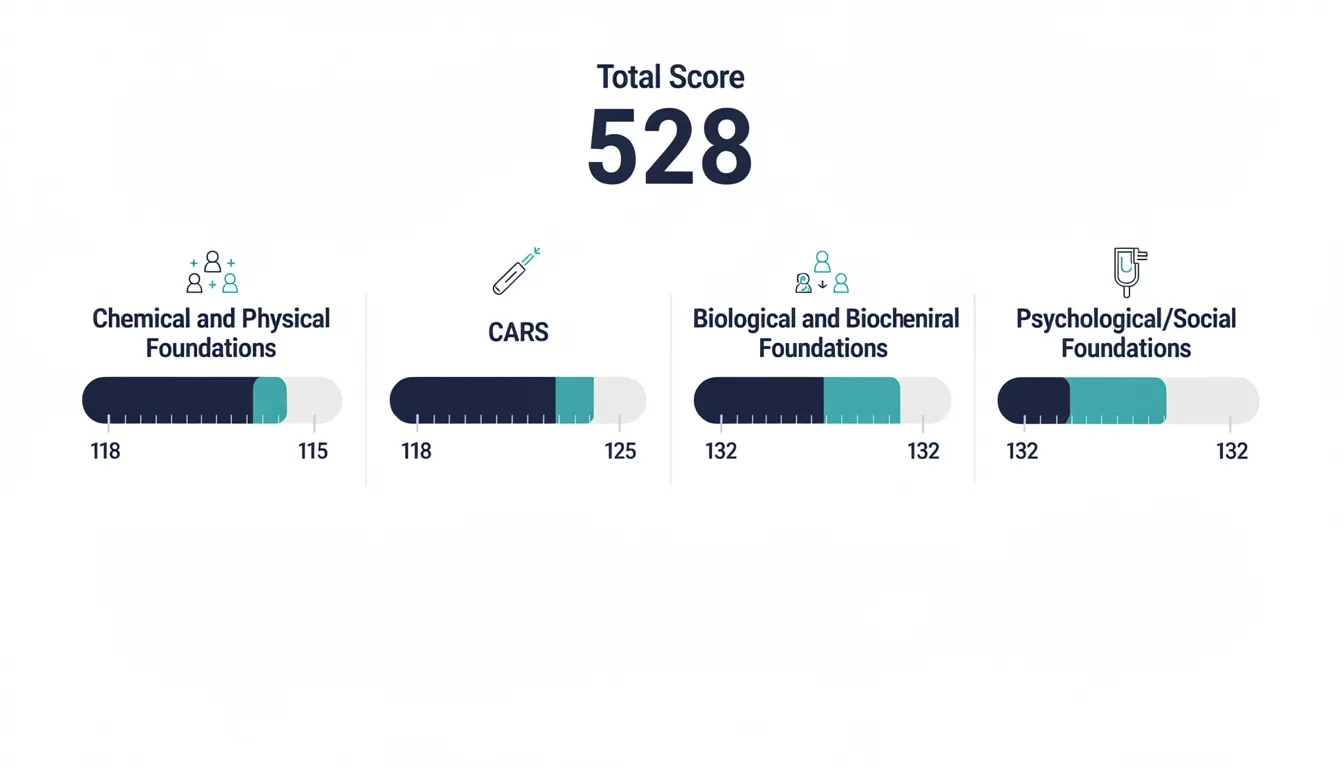
The MCAT has quietly ended a lot of promising pre-med trajectories. Not because those students weren't smart enough, but because they walked in treating it like a college science exam — something you can cram for the week before. The 2025 application cycle showed the average medical school matriculant scored a 511.8 out of a possible 528. That number doesn't come from a three-week sprint. It's the result of months of structured, deliberate work — and understanding what kind of test this actually is before you crack open a single review book.
What the MCAT Is Actually Testing
Four sections. Each scored from 118 to 132. Perfect score: 528.
The sections are Chemical and Physical Foundations of Biological Systems (Chem/Phys), Critical Analysis and Reasoning Skills (CARS), Biological and Biochemical Foundations of Living Systems (Bio/Biochem), and Psychological, Social, and Biological Foundations of Behavior (Psych/Soc). Together they run about 7.5 hours of testing on exam day (not counting breaks and check-in procedures).
The MCAT is more reasoning test than knowledge test. Ethan Bott, a 99th-percentile scorer who tutors through MedSchoolCoach, summed it up cleanly:
"The MCAT is a critical thinking test more so than a knowledge-based test."
This surprises pre-med students who are accustomed to dominating content-heavy science courses by memorizing facts. On the MCAT, you'll encounter unfamiliar experimental data and passages you've never seen before. The test is checking whether you can think like a scientist — not whether you can recite one.
The AAMC (the organization that writes and administers the test) publishes a full content outline at no cost, listing exactly which subjects are covered in each section. Most students never download it. That document should be your first stop before you buy a single prep book.
Score Targets by School Tier
Not every pre-med needs to aim for the same score. The right target depends on where you're actually applying — and being honest about that early saves a lot of wasted study time.
| School Tier | Example Programs | Typical Matriculant MCAT |
|---|---|---|
| Top 10 MD Programs | Harvard HMS, Johns Hopkins, UCSF | 521–523 |
| Strong MD Programs | State flagships, mid-tier privates | 512–518 |
| DO Programs | Most osteopathic schools | 504–508 |
| Regional / Lower-Ranked MD | Smaller allopathic programs | 507–511 |
A 510-512 gets you into serious consideration at most allopathic programs. Below 505, and the odds at MD programs get very steep. These ranges reflect AAMC's published applicant and matriculant data, not guesswork.
One non-obvious point: a strong MCAT score can partly offset a lower GPA, but a weak MCAT rarely gets rescued by anything else in your application. Admissions offices often filter by MCAT before they read your personal statement or look at your research experience. It's the section of your application with the least narrative flexibility.
When to Start (And Why Most Students Get This Wrong)
Students usually ask "how long should I study?" The more useful question is "how many total hours do I need?" Shemmassian Academic Consulting and most serious prep organizations put the floor at 300 hours, with competitive scorers often logging 350-500 depending on their baseline.
At 20 hours per week, that's 15-25 weeks. At 10 hours per week (common for students juggling upper-division coursework), you're looking at 30-50 weeks. Do the math before you pick a test date.
The practical implication: if you're targeting a March or April test date to feed into a June application deadline, content review should start no later than the previous September or October. Starting in January for a March exam means you'll almost certainly be rushing — and rushing on the MCAT shows up in your score.
Starting too late is the most common and most avoidable mistake. It forces brutal daily schedules, causes burnout before test day, and pushes students into taking the exam before their practice scores have had time to stabilize. There's also a prerequisite issue (which is more than most students plan for): all of your foundational science courses — general chemistry, organic chemistry, physics, biology, biochemistry — need to be complete before you start. Trying to learn organic chemistry from scratch during prep isn't studying; it's panic.
The Two-Phase Structure That Works
High scorers almost universally follow a two-phase prep structure. The phases aren't doing the same thing, and the transition between them matters as much as either phase alone.
Phase 1: Content Review (first 40-50% of your timeline)
Content review means rebuilding your scientific knowledge into something you can actually apply under pressure. Use a dedicated review book series — Kaplan's 7-book set, Princeton Review, or Blueprint all cover the material well. Watch Khan Academy MCAT videos for any concept that won't stick from reading alone.
Do low-volume practice questions after each content block, not to test yourself formally, but to catch gaps while the material is fresh. And do at least one CARS passage per day even during Phase 1. Don't wait until Phase 2 to start CARS — that's a mistake we'll revisit below.
Phase 2: Practice-Heavy Review (remaining 50-60%)
This is where the score actually moves. You're doing full-length practice exams under real conditions — desk, timed, phone off, same time of day as your actual test date — and then spending roughly as much time reviewing your wrong answers as you spent taking the exam.
After each practice test, log every missed question in what Shemmassian's guides call a Missed Questions Log (MQL). For each wrong answer, note the subject, whether the failure was a content gap or a reasoning error, and what the correct logic was. That log becomes a personalized study guide for your final weeks. Skipping this step is the single biggest difference between students who plateau and students who keep improving.
Section-by-Section Strategy
CARS
CARS is the section where pre-meds lose the most ground, and it's the one where extra content knowledge helps the least. There's nothing to memorize. The answers live in the passage.
The core CARS skill is reading for the author's argument, not for information. Top scorer Camille Villar described her method: read the full passage before looking at any question, highlight key claims and transitions, paraphrase each paragraph mentally as you go. That takes 5-7 minutes per passage. Questions then take 3-5 minutes.
The error most students make is reading CARS passages like a textbook — scanning for facts to retrieve. That's exactly backward. MCAT CARS questions ask about reasoning, tone, inference, and passage structure. Jack Westin (a widely-used free resource) publishes daily CARS passages that mirror real MCAT difficulty — a good daily habit that costs nothing.
Bio/Biochem
The highest-yield section for most pre-meds because it overlaps heavily with coursework. Biochemistry gets tested hard — amino acid structure and function appears far more often than students expect. Know your 20 amino acids and their properties cold before you sit for the exam.
Chem/Phys
General chemistry, organic chemistry, physics, and some biochemistry. The physics skews introductory: mechanics, fluids, electrostatics, waves. Organic chemistry questions are passage-based and lean toward interpretation and mechanism reasoning, not synthesis from scratch.
Psych/Soc
The most memorization-heavy section. You're expected to know named theories and researchers: Goffman's dramaturgical model, Freud's defense mechanisms, Weber's ideas on social stratification, Bandura's social learning theory. Khan Academy's free Psych/Soc videos are thorough and specifically mapped to the MCAT content outline — they're a legitimate primary resource for this section, not just a supplement.
Resources That Actually Move the Needle
Not all prep materials are created equal. Here's where to spend your time and money:
Non-negotiable (buy these first):
- AAMC Official Prep Bundle — full-length exams, Section Bank, Question Packs. The AAMC writes the test. Their materials are the most accurate simulation of real exam difficulty. Save the official full-lengths for the final 4-6 weeks of Phase 2, when your prep is closest to complete.
Highly recommended:
- UWorld MCAT QBank — questions run harder than the actual exam, which is a feature. The detailed explanations teach content and reasoning simultaneously.
- Blueprint MCAT — strong practice exams and adaptive study tools; good replacement for older Next Step materials.
- Khan Academy MCAT — free and genuinely solid for content review and Psych/Soc specifically.
Skip the shortcuts. Any course that promises you can "hack" the MCAT in minimal time is selling you false confidence. MedSchoolCoach reports that students working with their expert tutors score approximately 12 points higher than their diagnostic baseline — but that improvement comes from structured work, not tricks.
Mistakes That Quietly Sink Scores
Passive studying. Re-reading notes and watching videos feels productive. It isn't. Active recall — closing everything and reproducing a concept from memory — builds retention. Passive review builds familiarity, which is not the same thing.
Taking practice exams without reviewing them. An untouched wrong answer is a wasted opportunity. The exam is diagnostic feedback. If you don't analyze why you missed a question, you'll miss the same type of question again.
Treating all four sections the same. CARS needs daily practice. Psych/Soc needs memorization. Chem/Phys needs problem-solving speed under time pressure. One generic "study strategy" doesn't transfer equally across sections.
Registering for a date you're not ready for. The MCAT costs $335 to register. Sitting for it before your practice scores have stabilized at your target range wastes money and delays your application if you need to retake. Most competitive applicants retake at least once — but ideally not because they rushed the first attempt.
Bottom Line
- Set your score target before you build your plan. Work backward from your school list to figure out what you actually need.
- Start prep earlier than feels necessary. September for a spring test is not excessive — it's often exactly right.
- Use AAMC official materials as your scoring benchmark. Third-party resources build skills; AAMC materials tell you where you actually stand.
- Review wrong answers with the same rigor you bring to the exam itself. The Missed Questions Log is how you stop making the same mistakes.
- Do CARS passages every single day. No exceptions, no off days. Consistency is the strategy here.
The students who crack 515+ aren't necessarily smarter. They started earlier, studied more actively, and treated every practice exam as a diagnostic tool rather than a performance to be graded.
Frequently Asked Questions
How many hours should I study for the MCAT?
Most students who score competitively (510+) put in 300-400 hours of dedicated prep. That number can stretch closer to 500 if your science foundation is shaky. Hours matter less than quality — 300 hours of active recall and focused wrong-answer review outperforms 450 hours of passive reading.
Is it possible to study for the MCAT in one month?
Technically yes. Practically, it's a bad plan for most students. A one-month prep requires 7-8 hours of focused studying every single day, leaves almost no margin for life or error, and tends to produce burnout before test day. It can work as a retake strategy after a recent full prep cycle — not as a first attempt from scratch.
What's the difference between MD and DO program MCAT requirements?
MD (allopathic) programs are more selective, with matriculant averages typically above 511. DO (osteopathic) programs see average scores in the 504-508 range, though this varies by school. If your school list spans both, target a score that makes you competitive for MD programs — you'll be covered for DO programs automatically.
Is it a myth that CARS can't be improved?
Yes, that's a myth worth squashing. CARS improves with consistent, structured daily practice. What doesn't work is treating it like a content section and trying to memorize approaches. What does work is reading passages every day, categorizing your wrong answers (reasoning error vs. misread vs. time pressure), and building the habit of reading for argument rather than information.
When should I take AAMC official full-length practice exams?
Save them for the last 4-6 weeks of your prep. These exams are the most accurate predictors of your real score, so you want to take them when your preparation is near-complete. Use third-party full-lengths from Blueprint, Kaplan, or UWorld in earlier phases to build stamina and find weaknesses without burning your most valuable benchmark tools.
Should I use a prep course or self-study?
Self-study works well for disciplined students who can build and maintain a schedule without external accountability. Prep courses from Kaplan, Princeton Review, or Blueprint add structure and live instruction — genuinely useful if you tend to drift without a forcing function. The honest take: the resource matters far less than the consistency with which you use it.