SAT Math Formula Sheet: Everything You Need to Memorize
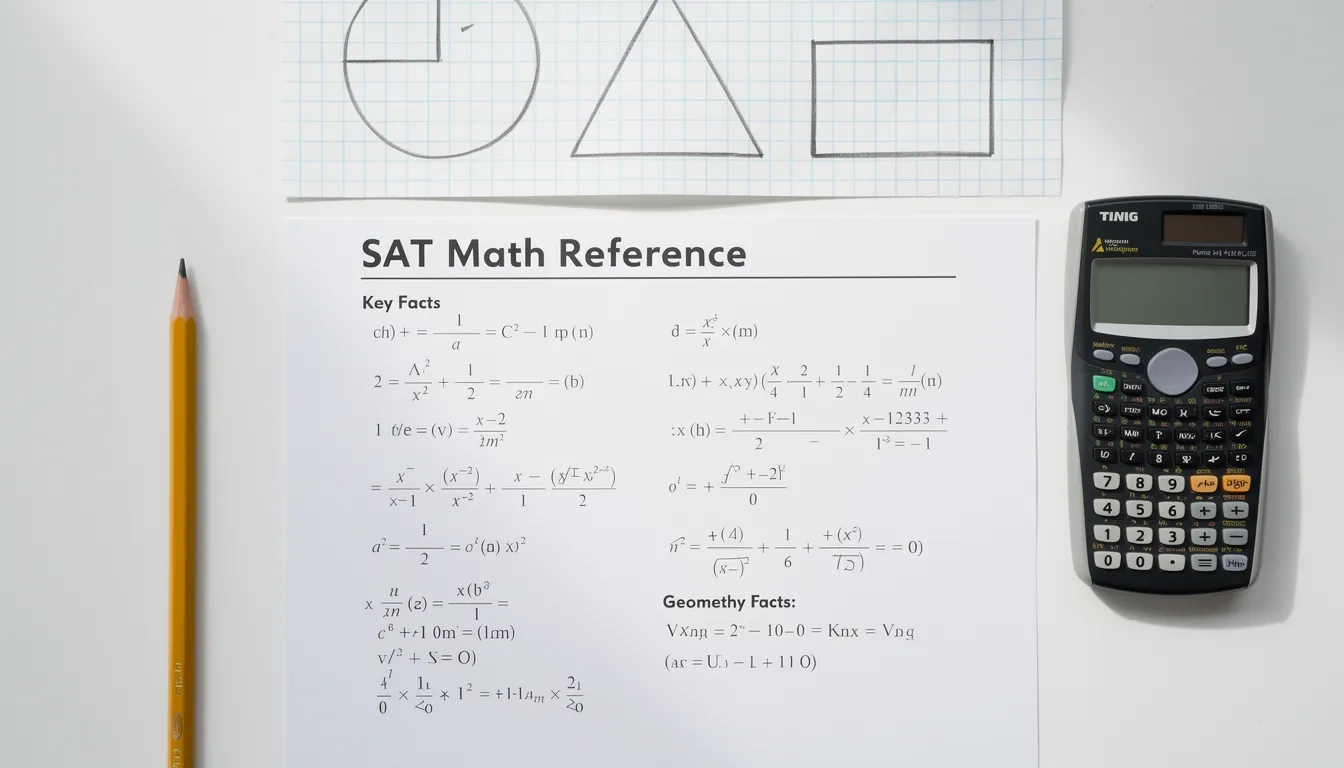
Here's what catches almost every student off guard: College Board hands you a reference sheet at the start of every SAT math section, and most people see it and breathe easier. Then the actual test begins, and question after question pulls from algebra, advanced math, and statistics — three domains where that sheet offers nothing at all.
The reference sheet covers 12 geometry formulas. Geometry makes up roughly 15% of the test. The other 85% is entirely on you.
If you've been treating the SAT like an open-book exam, this is the moment to recalibrate. The formulas that decide your score — quadratic formula, percent change, slope forms, exponential growth — aren't on any sheet. You need them cold.
What the Official Reference Sheet Actually Gives You
Knowing this list precisely matters, because students often misremember what's there and waste time checking for formulas that don't exist on the sheet.
College Board provides two clusters of information: area and circumference for 2D shapes, volumes for 3D solids, and three basic facts about angles and radians.
| Category | Formula |
|---|---|
| Circle area | A = πr² |
| Circle circumference | C = 2πr |
| Rectangle area | A = lw |
| Triangle area | A = ½bh |
| Pythagorean theorem | a² + b² = c² |
| 30-60-90 triangle | sides: x, x√3, 2x |
| 45-45-90 triangle | sides: x, x, x√2 |
| Rectangular prism volume | V = lwh |
| Cylinder volume | V = πr²h |
| Sphere volume | V = (4/3)πr³ |
| Cone volume | V = (1/3)πr²h |
| Pyramid volume | V = (1/3)lwh |
Plus three facts: 360° in a circle, 2π radians in a circle, 180° in a triangle.
Here's my honest take: even these 12 formulas are worth memorizing. The reference sheet exists, yes. But flipping back to it mid-problem breaks your rhythm and eats into your ~95 seconds per question budget. Across 44 math questions, those interruptions add up to real minutes of lost thinking time. Know everything cold and you give yourself that buffer back.
Algebra Formulas You Need to Know Cold
Algebra makes up roughly 35% of the SAT. The reference sheet provides nothing for it.
Slope and linear equations are the bedrock. Three forms, all mandatory:
- Slope formula: m = (y₂ - y₁) / (x₂ - x₁)
- Slope-intercept form: y = mx + b
- Point-slope form: y - y₁ = m(x - x₁)
Point-slope form trips students up because it looks messier than slope-intercept. But it's actually faster when you're handed a single point and a slope — you just plug and simplify rather than solving for b.
Two additional relationships for lines: parallel lines share the same slope; perpendicular lines have slopes that are negative reciprocals (if one slope is 2/3, the perpendicular slope is -3/2).
One commonly missed formula is standard form: Ax + By = C. College Board regularly gives equations this way and expects you to convert to slope-intercept. Practice that conversion until it takes you about 15 seconds.
Systems of equations don't have their own formula, but you need fluency in both substitution and elimination. Questions asking where two lines intersect show up across all difficulty levels.
Advanced Math: Quadratics, Exponents, and Exponentials
Advanced math is the other 35% of the test — and where the most points are left uncollected.
The quadratic formula is non-negotiable:
x = (-b ± √(b² - 4ac)) / 2a
This solves any equation in the form ax² + bx + c = 0. PrepScholar famously recommends memorizing it to the tune of "Pop Goes the Weasel," which sounds ridiculous until you realize it actually works for most students.
You also need all three forms of a quadratic, because each one answers a different question:
| Form | Equation | Best for finding |
|---|---|---|
| Standard | ax² + bx + c = 0 | Solutions via quadratic formula |
| Factored | a(x - r)(x - s) = 0 | x-intercepts (r and s directly) |
| Vertex | a(x - h)² + k | Vertex of the parabola at (h, k) |
The discriminant (b² - 4ac) is worth a separate mention. Positive → two real solutions. Zero → one. Negative → none. Questions that ask "how many times does this parabola cross the x-axis?" are really just testing whether you know the discriminant without making you solve the whole equation.
Exponent rules students most often forget:
- xᵃ · xᵇ = x^(a+b)
- (xᵃ)ᵇ = x^(ab)
- x^(-n) = 1/xⁿ
- x^(1/n) = ⁿ√x
The exponential growth and decay formula f(t) = a(1 ± r)^t appears in word problems about populations, radioactive decay, and compound interest. Don't confuse it with simple interest: A = P(1 + rt), which is linear. The difference matters — one compounds, one doesn't.
Two factoring patterns that save significant time on hard questions:
- Difference of squares: a² - b² = (a + b)(a - b)
- Perfect square trinomial: a² + 2ab + b² = (a + b)²
Statistics, Percentages, and Data Analysis
Problem-Solving and Data Analysis accounts for about 15% of the test. The questions look applied, but the formula gaps here are real.
Percentage formulas are tested more than students expect:
- X% of a number → multiply by (X/100)
- Percent change → (new - old) / old × 100
- What percent is A of B? → (A / B) × 100
Mean and the total-sum relationship is where most students miss easy points. The standard formula is mean = sum / count. But the version College Board actually tests is the rearrangement: total sum = mean × count.
Here's what that looks like in practice. Six students average 82 on a test — total points scored is 82 × 6 = 492. A seventh student joins and the new target average is 84. You need 84 × 7 = 588 total points, so the seventh student scored 588 - 492 = 96. That's a multi-step problem that takes about 40 seconds if you know the formula and about 3 minutes if you don't.
Also know:
- Median = middle value when sorted
- Mode = most frequent value
- Range = max - min
For probability: P(event) = favorable outcomes / total outcomes. For independent events: P(A and B) = P(A) × P(B).
Geometry Add-Ons and Trigonometry
The reference sheet handles basic shapes, but several geometry formulas are completely absent.
Circle equations in coordinate geometry use a form that never appears on the sheet:
(x - h)² + (y - k)² = r²
Here (h, k) is the center and r is the radius. Questions will give you this equation and ask for the center, ask for the radius, or give you both and ask you to write the equation. This is a fixture on medium and hard questions.
Arc length and sector area can be derived from the sheet's circle formulas, but recognizing them instantly is faster:
- Arc length = (θ/360) × 2πr
- Sector area = (θ/360) × πr²
Distance and midpoint formulas don't appear on the sheet but show up consistently:
- Distance: d = √[(x₂ - x₁)² + (y₂ - y₁)²]
- Midpoint: M = ((x₁ + x₂)/2, (y₁ + y₂)/2)
Trigonometry was added to the SAT in 2016 (any prep book older than that won't cover it properly). Nothing trig-related appears on the reference sheet. Memorize:
- sin θ = opposite / hypotenuse
- cos θ = adjacent / hypotenuse
- tan θ = opposite / adjacent
SOH-CAH-TOA handles those three. Beyond that, two identities worth knowing: sin²θ + cos²θ = 1 (the Pythagorean identity), and sin θ = cos(90° - θ) (the complementary angle relationship). Test writers love the second one.
For polygons: interior angle sum = (n - 2) × 180°, where n is the number of sides.
How to Actually Memorize All of This
According to Mathos AI's breakdown, there are roughly 45 distinct formulas you should know going into test day — the 12 on the reference sheet plus about 35 beyond it. That sounds overwhelming. It isn't.
A realistic two-week approach:
Week 1 — algebra and quadratics. These cover 70% of the test. Work through slope, the quadratic formula, all three quadratic forms, exponent rules, and exponential growth/decay. Write each formula by hand 10 times on day one. Then immediately do practice problems — flashcards alone build recognition, but you need application to build speed.
Week 2 — statistics, geometry extras, and trig. Percent change, circle equation, SOH-CAH-TOA, the Pythagorean identity, distance and midpoint. Same method: write it, then apply it to a problem within the same session.
The most common mistake is passive reading. Scanning a formula list and feeling vaguely familiar with it is not the same as knowing it. The practical test is simple: cover the list and try to write all formulas from memory. Anything you can't write immediately goes back to active review. Most students need about 3 cycles through this before everything is solid.
The formulas you can't write down under pressure are the ones you haven't actually learned yet.
Some students figure they can skip memorizing the provided geometry formulas since the sheet is right there. That's moving the goalposts on yourself. Reaching for the reference sheet mid-problem is a small tax per question. Over 44 questions, those small taxes buy back 8 to 10 minutes of thinking time if you eliminate them.
Bottom Line
- College Board's reference sheet has 12 geometry formulas covering roughly 15% of the test. Algebra, advanced math, and statistics — the other 85% — provide nothing.
- The six highest-frequency formulas you must know cold: the quadratic formula, slope-intercept form, percent change, the circle equation (x - h)² + (y - k)² = r², SOH-CAH-TOA, and exponential growth/decay.
- Spend week one on algebra and quadratics. Spend week two on statistics, geometry add-ons, and trig. Write each formula by hand and immediately practice applying it — passive reading doesn't build the automaticity you need at ~95 seconds per question.
- Memorize even the provided reference sheet formulas. The time you save not flipping back to it is time you keep for actual problem-solving.
Frequently Asked Questions
Does the digital SAT still provide a formula sheet?
Yes. College Board provides a reference sheet at the start of every math section on the digital SAT. It contains 12 geometry formulas: area and circumference of a circle, area of a rectangle and triangle, the Pythagorean theorem, special right triangle ratios, and five volume formulas. You can access it at any point during the section, but it only covers geometry.
What's the single most important formula to memorize for the SAT?
The quadratic formula: x = (-b ± √(b² - 4ac)) / 2a. It solves any quadratic equation and directly connects to multiple question types — finding solutions, interpreting the discriminant, and working with vertex form. If you only have time to nail one formula first, start here.
Is the percent change formula on the SAT reference sheet?
No. Percent change — (new - old) / old × 100 — is not provided anywhere on the test. Neither are most statistics formulas. Problem-Solving and Data Analysis makes up about 15% of the SAT but receives zero formula support from the reference sheet, making it a surprisingly high-risk area for underprepared students.
Do I really need trigonometry for the SAT?
Yes. Trig has been on the SAT since 2016, and none of it appears on the reference sheet. You need SOH-CAH-TOA for basic ratios, sin²θ + cos²θ = 1 for the Pythagorean identity, and sin θ = cos(90° - θ) for complementary angles. Most SAT trig questions are approachable once you have these memorized — the concepts don't go deeper than right-triangle trig and basic identities.
Is it a myth that strong math intuition can replace formula memorization?
Mostly, yes. Some students believe solid number sense lets them work things out from scratch without memorized formulas. For easy questions, that's occasionally true. But medium and hard questions — the ones that actually move your score — depend on fast formula recognition. At 95 seconds per question, deriving the quadratic formula from first principles is not a real option.
How do I know if I've actually memorized a formula vs. just recognized it?
Cover your formula sheet and try to write everything from memory. Recognition feels like memory but isn't. If you can write the formula cleanly, cold, in under 10 seconds, it's memorized. If you hesitate or get a sign wrong, it needs more work. Most students need 3 full write-from-memory cycles through the list before all 35+ formulas are genuinely solid.