SAT Study Schedule: 1, 2, and 3-Month Plans That Actually Work
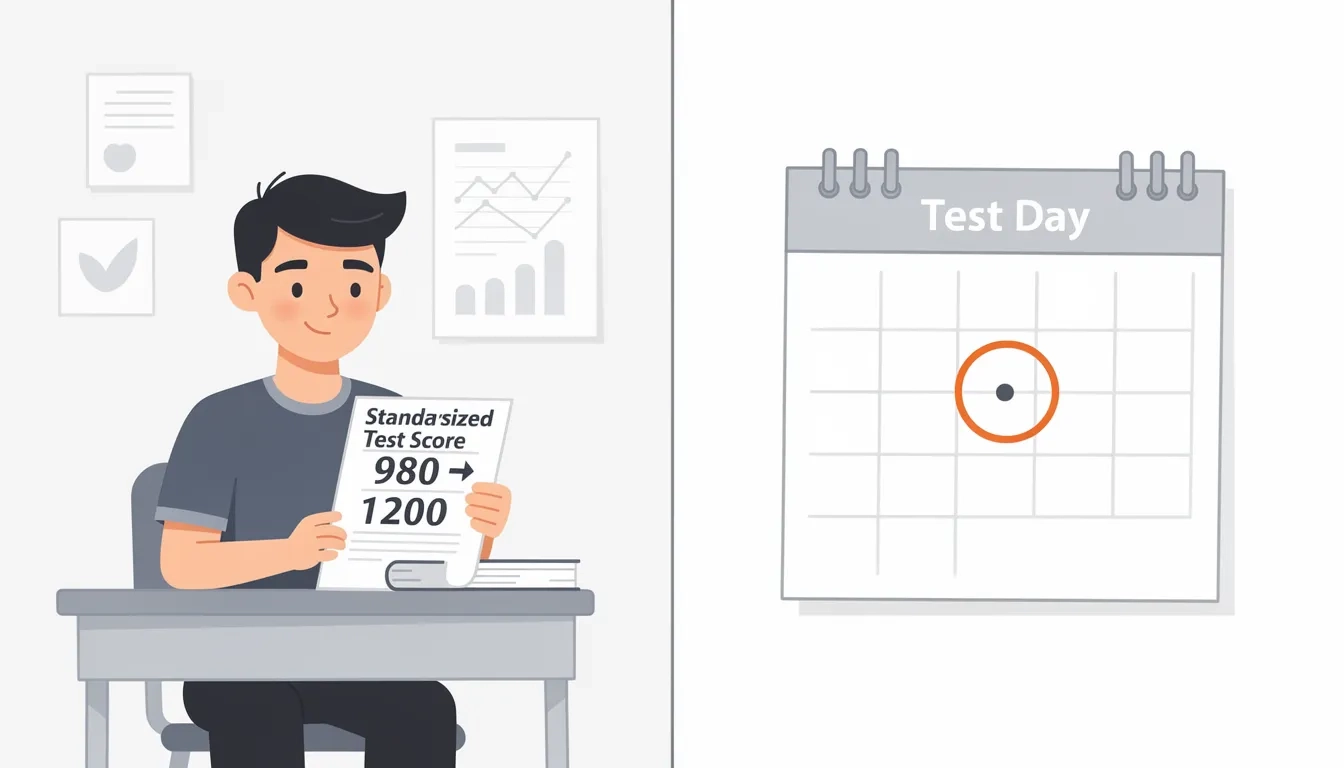
Most students start their SAT prep a week before the test with a vague plan to "do some practice." The scores reflect that. College Board's own data shows that just 6-8 hours of structured practice with official materials produces an average 90-point score increase. Get to 20 hours and the gain climbs to 115 points. The returns are real, but only if the hours are organized around a real plan.
Which Timeline Is Right for You?
Before picking a schedule, you need two numbers: your current score (from an actual diagnostic test) and your target score (based on the schools you're applying to). Your score gap determines your timeline. Not your confidence level, not your GPA.
PrepScholar's research maps the relationship between study hours and score improvement clearly:
| Score Improvement Goal | Hours Required | Best Timeline |
|---|---|---|
| 0–70 points | 10–20 hours | 1 month |
| 70–130 points | 40 hours | 1–2 months |
| 130–200 points | 80 hours | 3 months |
| 200+ points | 150+ hours | 3–6 months |
The most common planning mistake: choosing a timeline based on when you'd like to be done rather than how many hours your score gap requires. A student who needs 80 hours of work but has 30 available before test day will underperform no matter how hard they push in each session.
Take an official College Board practice test before you schedule anything else. Score it by section, not just total, then pick your timeline using the table above.
The 1-Month Plan: Triage Mode
One month is tight. It works well for two groups: students retaking the SAT who want to push their score up 50-130 points, and strong students who just need to shake off the rust and learn the format. If you're starting from a score below 1100 with a target above 1400, one month will not get you there.
Plan for 1-2 hours per day on weekdays and a 4-hour block on Saturday for a full-length practice test, plus 2 hours Sunday to review it. That totals roughly 40 hours, which maps to a 70-130 point improvement.
Week-by-week structure:
Week 1 — Reading & Writing Foundations
- Weekdays: Grammar rules (punctuation, transitions, subject-verb agreement), 30-50 questions per session with full error review
- Saturday: Full-length practice test under real conditions
- Sunday: Mistake analysis. Every wrong answer. No skipping.
Week 2 — Reading Comprehension
- Weekdays: Main idea, inference, and rhetorical synthesis questions (15-30 per type)
- Saturday: Timed section practice with strict 32-minute module timing
- Sunday: Review and note which question types cost you the most time
Week 3 — Math: Algebra and Advanced Topics
- Weekdays: Linear equations, systems, quadratics, exponential functions (25-50 questions per topic)
- Saturday: Full practice test
- Sunday: Error log — categorize each mistake by concept type
Week 4 — Math: Geometry, Statistics, and Final Polish
- Weekdays: Triangle and circle formulas, probability, data interpretation (20-40 questions per topic)
- Saturday: Final full practice test, phone off, timed breaks
- Sunday: Light review only. No new content.
Pick your two or three highest-leverage weaknesses based on what shows up most in your error log after week 1, and go deep on those. Trying to cover every topic in 4 weeks is a reliable way to cover none of them well.
The 2-Month Plan: Room to Learn
Two months is a different game. You have enough time to actually understand content rather than just pattern-match to question types, and enough practice tests to spot real trends in your errors.
Target 5 hours per week minimum at this timeline. At 8 weeks, that's 40 hours. If your score gap is in the 130-200 point range, bump to 10 hours per week.
Month 1 should be almost entirely content review. Spend weeks 1-2 on Reading and Writing, weeks 3-4 on Math. Most students skip this phase and jump straight to practice tests, then wonder why repeated drilling doesn't improve their scores. Doing 200 questions on a concept you don't understand just makes wrong answers feel familiar.
Take one full practice test at the end of month 1 as a mid-point diagnostic.
Month 2 shifts to speed and strategy. The question changes from "can I get this right?" to "can I get this right in 90 seconds?" Do two more full practice tests spaced 2-3 weeks apart, and spend as much time reviewing each test as you spent taking it.
One thing most 2-month plans miss entirely: training for the digital SAT's module-level adaptive structure. According to College Board, getting roughly two-thirds of Module 1 questions correct routes you to the harder Module 2, which has a higher score ceiling. A weak Module 2 performance can't fully compensate for a poor Module 1 routing. Deliberate accuracy in Module 1, not speed, is the single most important tactical priority on the digital SAT.
The 3-Month Plan: The Sweet Spot
Three months is what I'd recommend for most students. It's enough runway to cover all content without burning out, and enough practice test repetitions to genuinely internalize your error patterns rather than just noting them once and moving on.
Research from SATScoreCalculator's analysis of student outcomes suggests that students following a structured 3-month schedule typically see improvements in the 150-300 point range — making it the highest-return timeline for most test-takers.
Target 12-15 hours per week across 12 weeks. That puts you at 144-180 total hours.
Month 1: Build the Foundation
- Week 1: Full diagnostic test. Record section scores, not just totals. Note which question types you skipped or guessed on.
- Week 2: Reading and Writing fundamentals. All four categories: Craft and Structure, Information and Ideas, Standard English Conventions, Expression of Ideas.
- Week 3: Math fundamentals. Algebra accounts for about 35% of the Math section, so weight your review time there first.
- Week 4: First full practice test plus a 2-hour review session immediately after.
Month 2: Develop Real Skills
This is where students accelerate or plateau. The difference is almost always the depth of mistake review, not the volume of questions completed.
- Weeks 5-6: Advanced content in both sections — paired passages, complex word problems, circle theorems, systems with non-linear equations.
- Week 7: Adaptive testing mechanics. Practice pacing Module 1 deliberately so you stay accurate and get routed to the harder Module 2.
- Week 8: Second full practice test and review session.
Month 3: Build Mastery
Content review should be mostly wrapped up by now. Month 3 is about speed, stamina, and pressure tolerance.
- Weeks 9-10: Mixed timed practice drills, focused on question types that still cause errors.
- Week 11: Full practice tests 3 and 4. Take them at the same time of day as your actual SAT.
- Week 12: Scale back sharply. Thirty minutes of light review daily. No new material.
Four practice tests is the floor for a 3-month plan. Six is better if you have the stamina. Each test gives you more data about your personal error patterns. The more data you have going into the final two weeks, the more targeted your review can be.
How to Structure Individual Study Sessions
The plan is the map. But score gains live inside individual sessions, and most students run those sessions badly.
The completion trap is real: finishing 25 practice questions is not studying if you never figure out why you missed 8 of them. PrepExpert's research makes this blunt: spending 150 hours on questions without reviewing each mistake thoroughly won't produce significant score gains. The learning happens in the review phase, not the practice phase.
A session structure that works:
- Warm-up (5 min): Redo 5 questions you got wrong in the previous session, from memory
- Focused practice (25-35 min): One topic type, timed, no distractions
- Error review (15-20 min): For every wrong answer, write down why you chose it and why the correct answer is the only defensible choice
Keep sessions to 60-90 minutes (there are 52 years of working memory research backing that limit up, starting with Baddeley and Hitch's landmark 1974 model). Concentration degrades sharply after that threshold for most people, and longer sessions give you a false sense of productivity.
Which Resources Are Worth Your Time
You don't need a stack of prep books. You need official materials plus one strong supplementary resource.
| Resource | Best For | Limitation |
|---|---|---|
| College Board Official Tests | Accuracy — real questions, real format | Minimal explanation of wrong answers |
| Khan Academy SAT | Free, adaptive, imports PSAT data | Less depth on advanced Math |
| PrepScholar Blog | Strategy guides, error analysis frameworks | Can be verbose |
| Princeton Review / Barron's | Concept explanations, content review | Some content predates the digital format |
The most efficient pairing: College Board practice tests as your primary practice material, Khan Academy for concept review and adaptive drills. Their partnership allows Khan Academy to import your PSAT scores and generate a personalized practice plan. According to College Board's own data, students who used Khan Academy for 20 hours saw an average 115-point gain.
If you're targeting 1450+, you'll likely need to supplement with a dedicated prep book for advanced Math topics. Khan Academy alone has a ceiling there.
Bottom Line
Three months gives most students the best shot at meaningful score improvement. Two months works well for retakers with solid fundamentals. One month is for targeted, tactical gains, not wholesale score transformations.
The single most important variable across all three timelines: how seriously you review your mistakes. Students who understand every wrong answer they make consistently outperform students who simply log more study hours.
- Take a diagnostic test before touching any prep material — you need a baseline to know where to start.
- Pick your timeline based on your score gap, not your schedule preferences.
- Schedule practice tests first, then fill study sessions around them.
- Spend as much time reviewing each practice test as you spent taking it.
- In the final week, rest. No new content. Your brain needs consolidation time.
Frequently Asked Questions
Is one month actually enough time to prep for the SAT?
It depends on where you're starting and what you're aiming for. If you've taken the SAT before and already score above 1200, one focused month can push you 70-130 points higher. But if you're starting below 1100 and targeting 1400+, one month doesn't give you enough hours to close that gap. You need around 80 hours for a 130-200 point improvement, and that simply doesn't fit into 4 weeks at a sustainable pace.
How many hours a day should I study for the SAT?
Most students retain more from 60-90 minutes of focused daily study than from 4-5 hour weekend cram sessions. Consistent daily exposure compounds faster than binge sessions. The exception is practice test days — those are long blocks by design. If you're in a 1-month intensive, 2-3 hours per day is workable for a limited stretch, but don't try to sustain it without planned recovery time around practice test weekends.
Do I actually need full-length practice tests, or can I just drill sections?
Full-length tests are not optional. The SAT is close to 2.5 hours of sustained concentration, and that kind of stamina doesn't build from 30-minute section drills. Full-length tests also train you for the Module 1 routing dynamic: your accuracy on the first module determines which difficulty of Module 2 you receive, which determines your score ceiling. You can't train for that in partial practice.
Is Khan Academy enough on its own, or do I need a prep book too?
For students targeting scores below 1350, Khan Academy alone can get you quite far — especially since College Board's data shows its 20-hour users average a 115-point gain. But if you're aiming for 1450+, you'll run into Khan Academy's ceiling on advanced Math content. Pair it with a prep book for deeper work on harder algebra and geometry topics.
What's the biggest mistake students make with SAT prep?
Treating question completion as the goal. Students finish a set of 30 practice questions, check how many they got right, feel decent about the number, and move on. But the entire learning lives in the review. One wrong answer fully understood and categorized by concept type is worth more than 15 right answers breezed past. Build an error log. Every wrong answer, every time.
Sources
- How Much Time Should My Child Study on Official SAT Practice — College Board
- How to Build an SAT Study Plan: 4 Sample Schedules — PrepScholar
- Complete SAT Study Schedule: 3-Month Prep Plan — SATScoreCalculator.io
- 1-Month SAT Study Plan — Test Ninjas
- What Does an Ideal SAT Study Schedule Look Like? — PrepExpert
- What Is Digital SAT Adaptive Testing? — College Board Blog