Withdraw or Take the Bad Grade? A Real Decision Guide
It's week ten. The withdrawal deadline is two days away. You're sitting on a 44% in calculus, you've already missed three labs, and you keep telling yourself the final could turn things around. But the math doesn't support that. So: pull the W, or gut it out and risk the grade? Most students make this call based on gut feeling and half-remembered advice from a roommate. That's the wrong approach — because the consequences span your GPA, your financial aid, and potentially your grad school application, all at once.
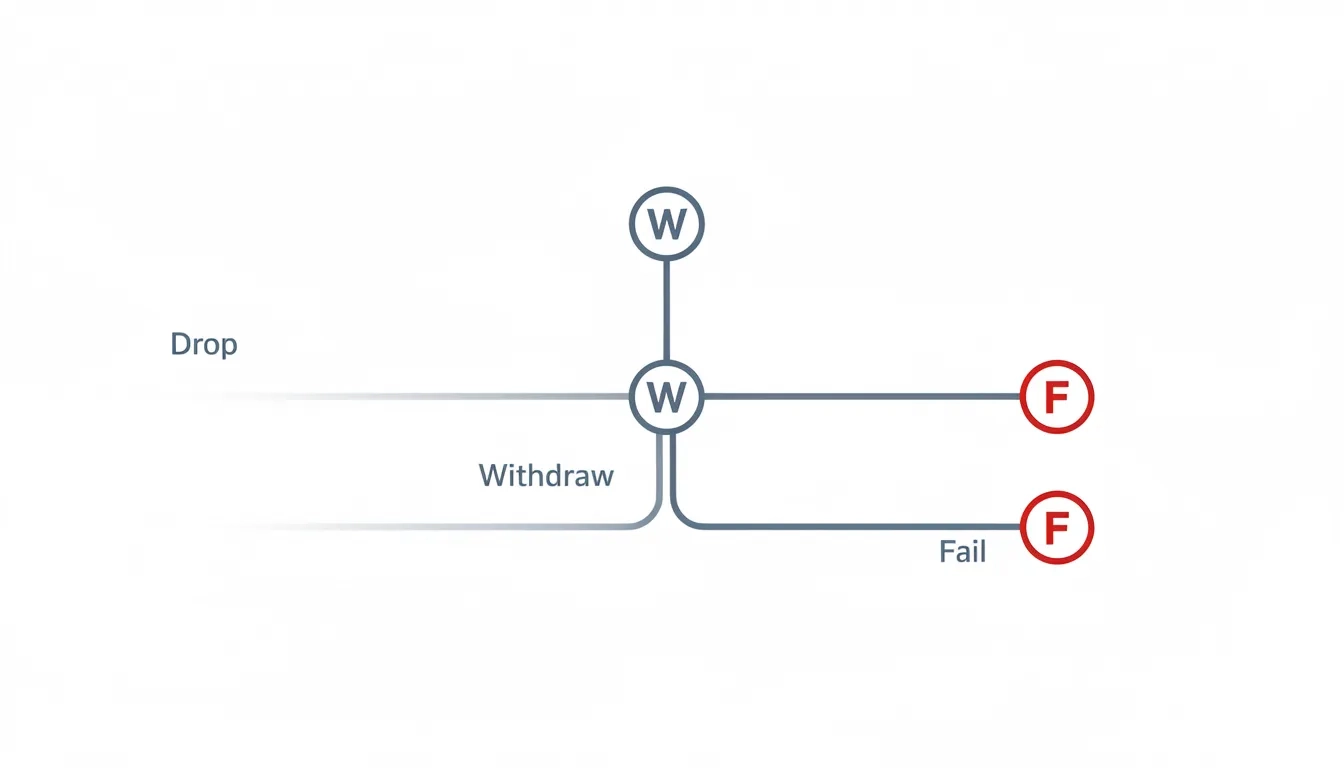
Drop, Withdraw, Fail: Three Very Different Things
Most students treat "drop" and "withdraw" as synonyms. They're not.
During the add/drop period — typically the first one to two weeks of the term — you can drop a course without any trace. No "W," no tuition charge, often a 100% refund. The class simply doesn't appear on your transcript. If you're in week one with serious doubts about a course, this is your lowest-cost exit by far.
A withdrawal happens after add/drop closes but before your school's withdrawal deadline, usually somewhere around weeks 8–12. You leave with a "W" notation on your transcript. That W doesn't factor into your GPA, but it does count as attempted credits.
A failing grade stays on your transcript permanently and directly damages your GPA. A D can also functionally fail you out of a prerequisite chain even if it "counts" toward credit hours.
One thing most students miss: some schools assign a "WF" grade — withdraw-fail — when you exit after the official deadline. A WF often hits your GPA just like an F. Your school's registrar page, not a friend's experience or a forum post, is the only authoritative source on how your institution handles this.
The GPA Math Nobody Bothers to Run
The numbers make the decision clearer than any advice column can.
Say you've completed 45 credit hours at a 3.2 GPA — that's 144 earned grade points. Now you're deciding what to do with a 3-credit course heading toward a bad outcome.
| Outcome | New GPA (48 total credits) | Change |
|---|---|---|
| Withdraw (W) | 3.20 | None |
| C (2.0) | 3.13 | –0.07 |
| D (1.0) | 3.06 | –0.14 |
| F (0.0) | 3.00 | –0.20 |
That 0.20-point drop from a single F sounds manageable in isolation. But the average GPA of students accepted to MD programs runs around 3.73, according to AAMC data. Moving from a 3.2 to a 3.0 in your science prerequisite GPA closes doors. And that's after a single bad grade.
The W, by design, costs you nothing on this math. That's its entire value.
One counter-intuitive point: a D in a prerequisite you need to retake anyway is often worse than a W. You fail the requirement, get the GPA hit, and still need to retake it. The W skips the GPA damage and gets you to the same retake situation.
Financial Aid: The Hidden Landmine
This is where the decision gets genuinely messy, and where most students never look.
The federal government requires all aid recipients to maintain Satisfactory Academic Progress (SAP). SAP has two main components: a GPA floor (usually 2.0) and a pace requirement — you must complete at least 67% of all credits you've ever attempted. Withdrawals count as attempted. They do not count as completed.
If you've attempted 45 credits and completed only 28, your pace is 62.2%. Below the threshold. You lose eligibility for federal aid. The appeal process exists but it's slow, bureaucratic, and not guaranteed.
Withdrawals count as attempted but not earned credits. One or two probably won't push you below the 67% completion mark. But if you've been withdrawing regularly, the math accumulates faster than students expect.
Dropping below full-time status (under 12 credits) creates a second problem. Pell Grant amounts are tied to enrollment intensity — full-time, three-quarter-time, half-time. Pull one course and your award can drop automatically mid-semester. Some private institutional scholarships carry their own minimum credit requirements, and those don't always align with federal rules.
The worst-case scenario: withdrawing from all courses before you've completed approximately 60% of the term triggers Return of Title IV (R2T4) rules. Your school is legally required to return some of your federal aid money. You could end the semester owing a balance you hadn't budgeted for. Talk to your financial aid office before you sign anything.
What Grad Schools and Med Schools Actually See
A single W, in context, is a non-issue. Admissions committees review thousands of transcripts. One course withdrawal, especially early in your college career, is unremarkable.
The pattern is what gets flagged. According to MedSchoolCoach, a W appearing in at least one course per semester suggests to reviewers that a student can't manage course load demands or recognize their own capacity limits. Multiple Ws concentrated in science prerequisite courses — the BCPM categories AMCAS tracks — carry the most weight, since those courses directly signal medical school readiness.
Timing matters too. A W from sophomore year in an elective reads differently from a W in organic chemistry during senior year. The latter implies avoidance, not a one-time life disruption.
One important fact for pre-med students: AMCAS does not factor W grades into your GPA calculation. The notation shows on your transcript and committees see it, but it won't numerically depress the GPA they evaluate. Most other graduate programs operate the same way.
If you have multiple Ws and are applying somewhere competitive, address it directly. A brief, honest explanation (illness, documented family emergency, mental health crisis) in your personal statement or additional information section lands better than hoping reviewers move past it. Vague excuses don't help. Context does.
A Decision Framework That Actually Works
Before you file anything, answer these four questions honestly.
1. Can you mathematically pull an acceptable grade? Don't estimate. Calculate. If remaining assessments are worth 55% of your grade and you're sitting at 40%, figure out the exact score you'd need on every remaining piece of work to pass. If that number is 91% when you've been averaging 52%, the situation is clear.
2. Is staying in this course damaging your other grades? This is the most underrated question. One course consuming 15 hours of stress per week while producing a failing grade is probably costing you a letter grade in two other courses. A W in one place can buy you a B in two others — and the net GPA impact is significantly better.
3. Is this a prerequisite you'll need to retake anyway? If you have to take this course again regardless, a W and a retake produces the same trajectory as an F and a retake. Except the W skips the GPA penalty. Withdraw and come back more prepared. (For AMCAS applicants: both an F and its retake grade appear on your application. A W avoids that problem entirely.)
4. How many Ws are already on your transcript? One or two: generally invisible to reviewers. Three or more: you're managing a pattern now, not an isolated incident. At that threshold, pushing through and earning a C signals something a string of Ws cannot.
The Timing Problem Is the Real Enemy
The withdrawal window is finite. It closes whether or not you've made up your mind — and that's where students get trapped.
The add/drop window is your cleanest exit. Two weeks, no transcript notation, often a tuition refund. If you're in week one already dreading a course, there's no strategic reason to wait. Every passing week narrows your options.
After add/drop closes, act as soon as you know the outcome is unlikely. Waiting until week 13 to file a withdrawal you knew you needed in week 7 is procrastination dressed as optimism. You still get the W, just with less time to plan around it.
Talk to three people before deciding: your professor (is passing actually possible?), your academic advisor (what are the degree and standing implications?), and the financial aid office (what happens to your aid?). The whole process takes maybe 47 minutes. It's the only way to make a decision based on your actual situation rather than someone else's.
My Take
The writing is on the wall by week 8 for most students who are truly failing. The question is whether they act on it.
A W is almost always preferable to an F, and often preferable to a D when you have no real path to a passing grade. The stigma around withdrawal is largely self-imposed. Academic advisors don't panic over a single W. Admissions committees see them constantly. What both groups actually notice are students who stayed in courses they couldn't pass, tanked their GPAs over multiple semesters, and spent years trying to recover.
That said, the W is not a free reset. The SAP clock, the tuition already paid, the prerequisite you'll retake — all of that still counts. Use it as a deliberate tool, not a reflex.
Bottom Line
- Run the grade math before doing anything else. If the score you'd need on every remaining assignment is unrealistic given your performance so far, that's a concrete answer.
- Talk to financial aid before filing a withdrawal. A single course drop can reduce your Pell Grant, push you below the 67% SAP completion threshold, or — if you're withdrawing from everything — trigger a balance owed under R2T4 rules.
- One W is invisible. A pattern isn't. Use withdrawals strategically, not as a default stress response.
- The add/drop period is your best window. No trace, possible refund, zero consequences. If you're in week one with serious doubts, leave.
- For pre-med and grad applicants: A W doesn't affect your AMCAS GPA. Multiple Ws in science prereqs need an explanation. One, in context, usually doesn't.
Frequently Asked Questions
Does a W on my transcript affect my GPA?
No — a standard withdrawal does not factor into GPA at most institutions. It counts as attempted credits for SAP purposes, but carries no grade points. The exception is a "WF" (withdraw-fail) that some schools assign after their withdrawal deadline, which can function like an F in GPA calculations. Check your school's specific policy.
Is it always better to withdraw than fail?
Not always. If the course is a prerequisite you'll need to retake regardless, a W avoids the GPA hit with the same outcome, making it clearly better. But if you can realistically earn a C or better with focused effort, staying is often smarter — you avoid another W on your record and demonstrate persistence.
How many withdrawals is too many?
There's no universal threshold, but most advisors and admissions professionals start noticing a pattern around three or more. One or two Ws across a four-year transcript are common and rarely questioned. Ws concentrated in the same subject area or in consecutive semesters attract more scrutiny.
Will a withdrawal hurt my financial aid?
Possibly. Withdrawals count as attempted but not completed credits, which affects your SAP pace requirement (federal standard: complete at least 67% of all attempted credits). They can also reduce enrollment intensity below full-time thresholds, directly affecting Pell Grant and loan eligibility. Always consult financial aid before withdrawing.
Is a W worse than a C for medical school applications?
For most applicants, a C is better than a W — it demonstrates you stayed and produced something, even if modest. But a W is significantly better than a D or F in a science prerequisite. MedSchoolCoach notes that a single W rarely affects admissions decisions; the concern is a recurring pattern, especially in BCPM-category courses.
What's a medical withdrawal, and is it treated differently?
A medical withdrawal is granted when documented health circumstances — illness, hospitalization, mental health crisis — forced you to leave a course or semester. Many schools treat these more favorably than standard withdrawals: they may not count against your SAP pace, can come with tuition refunds, and are viewed with more understanding by admissions committees. They require documentation, but they're worth pursuing if your situation genuinely qualifies.
Sources
- Does Withdrawing from a Class Affect GPA? | Bold.org
- Dropping a College Course in 2025: Transcript and Aid Impact | The College Monk
- Does a Withdrawal (W) Look Bad for Med School? | MedSchoolCoach
- Should My College Student Withdraw from a Difficult Course? | CollegiateParent
- Federal Satisfactory Academic Progress Standard | BMCC/CUNY